Basically it is a full professional grade telescope processing pipeline in your browser. It does 2 queries to some custom databases to identify known asteroids and stars, but all image processing and calculations are done in the browser. This means the backend is pretty tiny. That said it is running on an old box in my closet, so queries may take a while if it gets hammered.
I built it since I have worked with quite a few astronomers over the past 4 years and I keep watching them do the same steps, purely built to make my friends lives easier. I wrote it all in rust and managed to compile it into wasm. With some help from fable as I am not a frontend guy at all, I built it into a small website.
Some of the code is public, the orbital mechanics code I wrote while I worked at Caltech. Which is being used on SphereX, NEO Surveyor, and the Roman telescopes to identify known asteroids.
https://github.com/dahlend/kete
The writing style has significantly improved, however the token burn rate for tasks I have been working on seems to have skyrocketed. It definitely appears more capable (though I am unclear how much of that is just me liking the English it writes now vs actually more performant). I was using Fable 5 for some mathematical analysis assistance and redoing a part of it with 5.1 burned 60% of my session at a much faster rate.
This. It seems to light my usage of my max plan on fire. I’ve gone back to opus because I run out of usage in my five hour window so much more quickly.
Strictly from an energy conservation argument this doesnt make a whole lot of sense to me. Just some back of the envelope math if they take their current mirror size, make 50k of them and overlap all of the output on the same 3 mile spot (the spot size they claim they will get on a single mirror). With an ideal reflector it is still less than mid-day daylight. Thats 50k satellites to give you direct sun over one 3 mile spot.
I suppose to make this feasible they would have to up the size of the mirrors. Unless this is somehow dirt cheap I can't imagine farmers or solar operators buying this.
I am a researcher studying orbital dynamics of asteroids/comets/dust. I made a very precise visualization tool for the solar system, it shows the motion of all of the known asteroids. When you click on a specific asteroid it will then show the hyper precise orbit for it which matches JPL's orbit calculations (full physics, n-body, relativity, non-spherical planets).
Research grade orbital mechanics, specifically of asteroids/comets.
I've been working on it for 4 years now, finally tried using some AI tooling the last few months and ended up vibe coding a fun little visualization.
Working on orbital dynamics code for my PhD in astronomy, written in rust, it can accurately calculate the positions of all asteroids/comets to within a few meters. Today I am adding a new numerical integration method which should enable me to predict orbits from observations.
Its an implementation of a pretty standard integrator used by astronomers informally called "RADAU", but it is not exactly the same RADAU you would find elsewhere. Basically it is about as good as you can typically get for multi-step integrators, tuned for speed not precision though.
Note that how the code is laid out you cant really simulate non-solar system masses. Its really aimed at massless objects in the solar system, your 3-body simulations are actually quite difficult to do given the design.
I suggest the appendix of the arxiv paper if you want to see some of the math required for solar system objects beyond simple Newtonian gravity (like Relativity corrections). I wrote that section specifically because I found it a pain in the ass to source those equations in literature.
This includes about 1.3 million known asteroids (most of the known ones), so the page is like 45mb. Consider yourself warned.
This is a plot of semi major axis, orbital eccentricity, and inclination of the orbit. The blobs are collisional groups, where a bigger rock(s) got smashed into 'families' of asteroids. Color is by the absolute magnitude H, which is a normalized, log scaled, brightness measurement. Typically smaller H means larger object.
You can see the Kirkwood gaps clearly along one axis, but as you move around you can see more complex orbital resonances. These resonances pump energy into or out of the orbit of the asteroid, causing them to leave the resonance after some time, depleting the region of phase space.
Source: I do solar system simulations for my PhD work.
One good reason to keep the raw data and orientation separate is hardware calibrations. I see some discussion here along the lines of "why not just flip the data before saving it", and one counter-argument is that you should store the flip metadata anyways, as it important to trace which hardware pixel corresponds to which stored pixel. I realize this information is not vital for everyone, but it is super useful in fields where you need to characterize the hardware performance at the pixel level (for example astronomy).


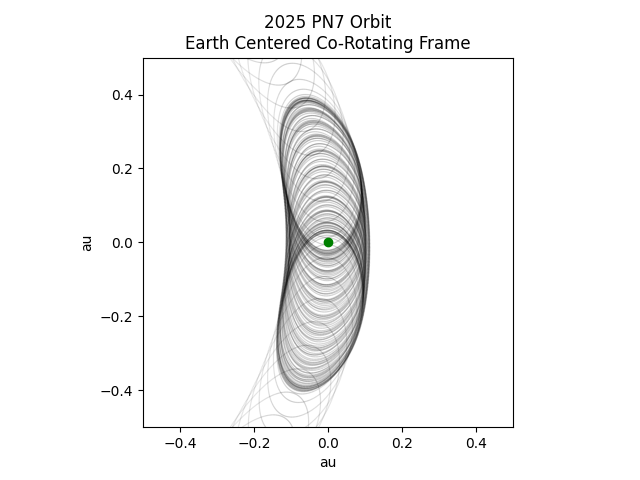
I have slowly built out a set of tools for asteroid orbits and photometry (measuring how bright stars/asteroids are).
It is very rough still (Desktop only), and it only supports the FITs file standard.
https://www.astrometry.space/
Basically it is a full professional grade telescope processing pipeline in your browser. It does 2 queries to some custom databases to identify known asteroids and stars, but all image processing and calculations are done in the browser. This means the backend is pretty tiny. That said it is running on an old box in my closet, so queries may take a while if it gets hammered.
I built it since I have worked with quite a few astronomers over the past 4 years and I keep watching them do the same steps, purely built to make my friends lives easier. I wrote it all in rust and managed to compile it into wasm. With some help from fable as I am not a frontend guy at all, I built it into a small website.
Some of the code is public, the orbital mechanics code I wrote while I worked at Caltech. Which is being used on SphereX, NEO Surveyor, and the Roman telescopes to identify known asteroids. https://github.com/dahlend/kete
reply