> Microsoft has done a lot of super shady things, and they are domiciled in a hyper-corrupt, lawless threat to humanity (one that elects quite possibly the stupidest human alive -- a rapist abomination halfwit clown -- to the highest office),
I generally dislike Microsoft because they make crappy products, but does this add to your point? I don’t think so, and it’s largely incorrect.
For example I despise Donald Trump but you can’t be the stupidest human alive and be president. It’s just objectively false.
The US is one of the few (arguably the only) countries holding the barbarians at the gate - the ones who are a threat. Frankly, the Dutch have historically been the greater threat to humanity and we saw the devastation and destruction wrought by their colonialism (which the Dutch haven’t paid reparations for in total) unleashed upon the world.
Yes? Donald Trump, and the fact that he is the symptom of a fallen empire that has reverted to being an idiocracy, flailing around and trying to bully its way to a lost dominance that is fading away, is precisely why the Dutch government is doing this. It's quite literally the subtext of this discussion.
And for that matter, it's why all American companies are going to find their reach shrink. Visa and Mastercard are worldwide systems whose days are numbered, for instance. The US banking system is being ejected everywhere it is found.
> but you can’t be the stupidest human alive and be president. It’s just objectively false.
I mean, I guess people actually vote for this pathological liar / megalomaniac who is a lifetime failure in every dimension, so true. They're even worse. But Trump is objectively a profoundly stupid person. It's actually astonishing now how he is basically a simpleton in the White House, lying with every utterance, and it's just another day. It isn't even newsworthy. Oh yeah, his big TrumpTM Arch is now going to have drones and snipers! Also, how about that fantasy deal with Belarus for all that potash that doesn't exist, was farcical nonsense on its face, yet everyone reports it because this foolish liar just makes up stuff endlessly so it isn't even notable. Aren't Americans just unbelievably ashamed at how pathetic this loser is, or that he lies -- usually in the cause of pushing his greatness -- with every other word?
Seeing Xi mog this pathetic chimp yet again was amazing stuff. The world is yours, China.
> The US is one of the few (arguably the only) countries holding the barbarians at the gate
This has to be a joke. There is no way anyone on this planet is so deluded and misinformed.
When you watch those sci-fi shows and folks have nanobots implanted in them that heal wounds really fast or do other cool things I can't help but think in many ways we already have that technology we just need it to do more, faster as our brains and ability to create things have outpaced the rate of evolutionary change.
I don't mind analogue buttons or anything and I think screens can kind of suck especially with Android and auto manufacturer abandonware, but with the Tesla I now own I'm always wondering what people are using all these buttons for - thinking back to my previous Hondas. In the Tesla I've got climate control, heated seats, and music/navigation. Some of the other features like adjusting mirrors I can use the multi-purpose buttons for in the correct context. On any given drive I hop in, put my phone on the charger and don't use it, and then just drive.
What am I missing? Or is it just that folks want buttons? Is it the design?
I absolutely need to be able to turn off the headlights when driving on a RORO ferry at night. Auto headlights are great, but for some reason they don't read the WSDOT sign that tells us to turn off our lights; not very smart really. Having a stalk or a knob for wipers is basic and easy; again auto wipers are pretty nice, but sometimes I want to force it because the auto system is being silly.
I really like having dedicated buttons to disable driving assistance. It's handy when you're going through a drive through and you want to disable parking beeps that remind you not to run into the building. It's also handy if lane following gets annoying when road conditions demand ignoring the lane lines. I think NHTSA pushed to remove easy access to disable assistance though?
I don't mind using a screen for things I don't need to do while in motion. Like if I want to set if the car should beep when I lock the doors, or how many times the blinker should blink if I tap it and didn't mean it but it wants to be helpful... screens are wonderful for that. But if I need to focus on a screen to do things while I'm driving, I've lost focus on the surroundings.
Of course the buttons are for doing things. The things you listed are pretty much all the traditional buttons. I can remember as a kid paying attention to the center panel between the foot wells (in a Corolla!) - it was pretty much just heating/AC, radio, and a few miscellaneous things like hazard lights. It's no airplane cockpit or space shuttle.
Also if you had electric door locks and windows (we didn't) the driver's door had 4 window levers and a child lock button while everyone else had their own window lever.
I hear ya. I can't speak to other cars but in my Tesla I never have to fiddle with any of that stuff. I just press the button on the screen for example to modulate the climate control even when the car is in motion - I don't need to look at all. There's no feedback (haptic feedback would be a nice improvement actually). In the rare instance that I need to do something "complicated" I'd just put the car into the Autosteer mode. But that's only something that would really be done on the highway in a safe manner. In my older cars I found using the buttons to switch between say albums or something that to not really be that much easier. Maybe slightly worse.
On the other hand, boy when I get a rental car there are so many buttons to mess around with it's like going backwards in time (for me) in terms of ease of use. Even something like having to turn on/off the car itself is now a chore. Why do I need to even turn the car on? It should just always work. Obviously part of that is "it's a new car" but a lot of that stuff seems very needlessly complex. I'm not talking about turning the heat on or off even though a lot of those implementations seem way more complicated than they need be (engineers gonna engineer and over-complicate things unless someone stops them) but other random things.
I have a Suzuki Grand Vitara 2010, and from left to right, the essentials buttons are (grouped by location):
- Window controls and lock/unlock
- Power mirrors adjustment (after someone else has driven the car)
--
- Light stick/knob (it has auto mode)
- Steering wheel control for the head unit (vol +/-,...). It also has cruise but I don't use that
- Wiper and washers stick/knob
--
- AC adjustment. It's a knob for temperature with 2 buttons inside (auto mode toggle and off)
- Fresh/recycled air switch
- AC/ventilation switch
- Ventilation speed. It's also a knob with 2 buttons, but I only remember the mode one (to switch between front/front and feet/heater/...)
- A defrost button
- ESP (ABS) disable button
--
- Window/door lock/ on the passenger door.
There's nothing else. For any of those buttons I would hate to use a touch screen. With physical controls, I can rely on location, haptic, and muscle memory without using vision.
The Tesla I have has a few buttons for those things. For the other items where buttons don’t exist I don’t really need to use vision. The digital button is just right there but I think haptic feedback would be an improvement too. I think people also underestimate how much they look even when using physical buttons. You can’t really help it. You’ll glance down as you adjust that knob from warm to cool, maybe you like it with 4 indicator lights instead of 5 so you’ll just take a peak there. Nobody has their eyes on the road 100% of the time.
Some of the buttons you mentioned you have dedicated buttons for but at least for the Tesla some of those adjustments you do while parked and just swap the button mode. It allows for multi-use buttons which is pretty cool.
I’m not arguing against buttons or something to be clear, just sharing my experience. It seems like some other cars have a lot of unnecessary ones.
What you are missing is you can press the button blind while you are looking at the road, the button merely closes a circuit and always works.
But I'm talking beyond just the buttons. Pure analog. No telemetry. No cellular connection. Real rack and pinion again. Real gauges. No drive by wire wherever possible. Maybe the actual ev motor output can be controlled with a simple switch in the circuit vs an entire ecu with throttle profiles and all the bullshit. Basically, your car in 2003, with the gas engine replaced with an electric motor. Pure car. Dead simple systems. Easy access engine bays.
It isn't happening again. These things are ipads on wheels that try and surveil you and come up with datapoints they can somehow make some money off of.
> What you are missing is you can press the button blind while you are looking at the road, the button merely closes a circuit and always works.
Not just that: my hands get dry enough sometimes that my phone's touch interface doesn't work reliably, in which case, I'd expect a touchscreen interface in a newer car would face similar problems. Physical buttons don't have that problem.
> Maybe the actual ev motor output can be controlled with a simple switch in the circuit vs an entire ecu with throttle profiles and all the bullshit. Basically, your car in 2003, with the gas engine replaced with an electric motor.
Your gas car in 2003 probably directly connects the accelerator pedal to the throttle ... but it also has an entire ecu with a whole bunch of stuff to figure out how much fuel to add given the throttle position / airflow and also almost certainly has the ecu controlling ignition too. Even my 1981 van has an ECU to sets fuel volume, although it doesn't have electronic ignition or water cooling.
You can open the throttle all the way, and if the fuel volume doesn't change, you won't get much in the way of extra vrooming.
That said, as simple as possible, but no simpler is a good goal.
Diesels often don't actually have a throttle like gas engines do. The accelerator pedal on a diesel is not connected to a throttle body regulating air intake... instead the air intake is classically wide open (but modern diesels do have airflow controls to adjust emissions profiles) and the accelerator position allows more or less fuel. If your ECU controls fuel delivery (as ECUs have been doing in gas cars since at least the 1970s) and the pedal's job is to ask for more or less fuel, it's going to be connected to the ECU... You can tug on a cable and turn that into an electrical signal at the ECU (or wherever) or you can turn it into an electrical signal at the pedal. Seems simpler to do it at the pedal.
A gas car has the pedal setup to open the throttle valve and let in more air and then some additional system for more air is more fuel... an ECU in open loop measures the airflow and engine temperature and triggers the injectors for a certain amount, in closed loop it will read the o2 sensor and adjust fueling to get the right mix.
If you move to drive by wire, now you have an electrical signal for the pedal, but you didn't necessarily simplify the system because you also have to add a way for the ecu to control the throttle valve or otherwise regulate intake airflow.
I'm not really concerned with hitting the button blind but I understand the desire to have no "tracking" or anything like that. Volume in the Tesla at least there is a button and you can configure some of those things with software. I know the heated seats and climate control are done via the iPad as you call it but I don't have to look at those. Once you hit it enough you just know where it is, or you can use voice control if you're not that comfortable. I can also text on my iPhone pretty well without looking at the keyboard.
But I'm not sure what I'm supposed to do with all these gauges and stuff. I have 0 interest in trying to repair my car or understand how any of it works. I just want to get in, have it be super comfortable, everything works and it gets me from A to B pretty fast. The only gauge I care about is the speed at which the car is traveling. Well the battery too I guess but if I'm taking a trip where that's of concern the car handles the stops for me.
I get that people do enjoy that stuff which is super cool - I'm not hating on it, but figured I'd just provide a different perspective maybe. For me the biggest concern is just this dog shit Android software and abandonware that all the manufacturers create (except Tesla funny enough - I'm not a shill or anything, Elon sucks and I'll never buy another one because of him) which I think is probably the biggest negative to the iPad-ification. Thankfully there's Android Auto and Apple Car Play but still the computers in the cars can be underpowered to use those.
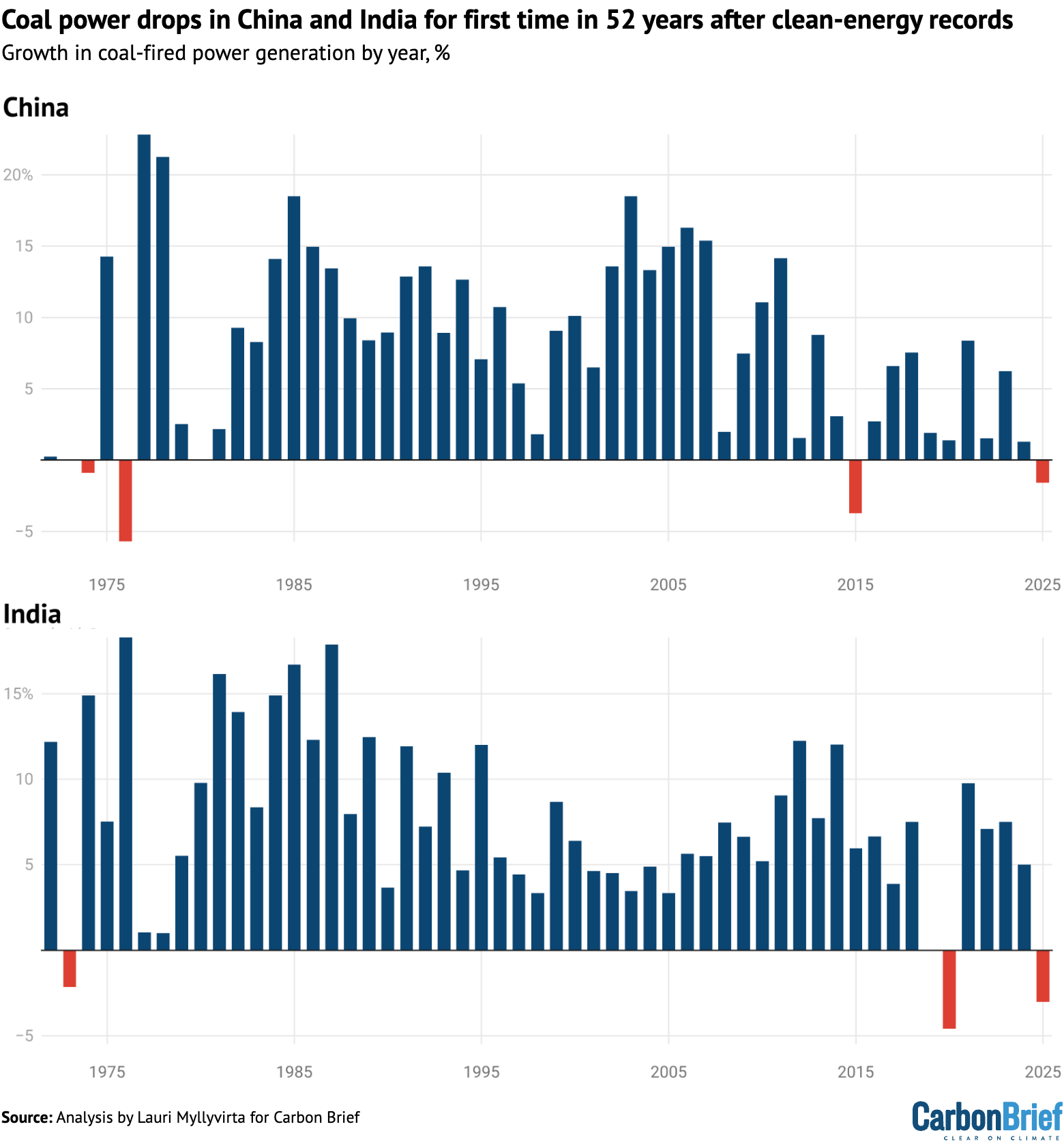
Maybe emissions fell because industrial activity fell instead? Maybe oil and gas have been used less because the cost has risen. Maybe that explains coal as well depending on how it is used. I’m speculating coal might be used in the production of steel - what if that product is highly tariffed in the US and EU so China had to cut back?
China is “greening” but we should be skeptical that it’s out of some lofty moral goal. If it was they wouldn’t be hoarding the production of rare earth minerals and would be freely giving away technology for the sake of the planet.
> China is “greening” but we should be skeptical that it’s out of some lofty moral goal
Why does the "why" matter? Tons of carbon are tons of carbon, right? That's what people say when you tell them about per-capita emissions.
> they wouldn’t be hoarding the production of rare earth minerals and would be freely giving away technology for the sake of the planet.
You can freely buy as many cheap panels and batteries and EVs and heat pumps from China as you like (unless your country is stupid enough to tariff or ban them). Those come with minerals. When they reach end-of-life they can be recycled.
What exactly are they "hoarding" that the planet needs to go green? It hasn't prevented Pakistan or Vietnam from going ham on PV deployment.
Well it doesn’t entirely matter but we should just acknowledge that it’s a geopolitical strategy and not really something they are doing for the planet.
> You can freely buy as many cheap panels and batteries and EVs and heat pumps from China as you like (unless your country is stupid enough to tariff or ban them). Those come with minerals. When they reach end-of-life they can be recycled. What exactly are they "hoarding" that the planet needs to go green? It hasn't prevented Pakistan or Vietnam from going ham on PV deployment.
Are you unfamiliar with China’s restrictions on rare earth exports for example due to alleged “dual use” as they continue to apply military pressure on democratic Taiwan? I’d encourage you to read up on these restrictions with respect to Japan for example who is alarmed by Chinese and North Korean provocations.
You can buy so many cheap panels practically only from China because they subsidized the industry so other countries couldn’t compete and build their own solar panels. For some these tariffs and bans are responses to these anti-competitive strategies. It’s not just the US, by the way. The EU is tariffing China too.
They are entitled to pursue these strategies but we are also entitled in the west to recognize them and combat them how we see fit.
> not really something they are doing for the planet
If it doesn't matter why do you feel the need to acknowledge it?
> Are you unfamiliar with China’s restrictions on rare earth exports [to Japan] for example due to alleged “dual use”
How do these restrictions prevent Japan from using Chinese PV and batteries in their grid?
> You can buy so many cheap panels practically only from China because they subsidized the industry
Translation: they gave the world a ton of deeply discounted goods. And you said they didn't do anything nice for anyone!
> so other countries couldn’t compete and build their own solar panels
Other countries are free to subsidize their own solar and battery industries. Godspeed to the ones doing it right now. But also is it really that amazing an industry to have? Low-margins, constant price wars, undifferentiated commodity product without much of a moat. Rich economies tend not to have those industries anyway.
> For some these tariffs and bans are responses to these anti-competitive strategies
Surely then the US must be approving solar projects at record pace then? And wind too?
> The EU is tariffing China too.
There are no EU tariffs on Chinese solar panels or grid-scale batteries or heat pumps. They are considering tariffing heat pumps right now.
> If it doesn't matter why do you feel the need to acknowledge it?
Just to make sure nobody is ever confused. Why do you feel the need to defend China?
> How do these restrictions prevent Japan from using Chinese PV and batteries in their grid?
It limits Japan from developing their own home grown market or utilizing technology for what China considers dual use?
> Translation: they gave the world a ton of deeply discounted goods. And you said they didn't do anything nice for anyone!
Other translation: Those cheap goods weren’t worth the cost to the environment or to empower an autocratic regime.
> Other countries are free to subsidize their own solar and battery industries.
When that happens there can be retaliatory measures against countries who are in for example the WTO or have other trade agreements. You don’t just subsidize products in a vacuum.
> Godspeed to the ones doing it right now. But also is it really that amazing an industry to have? Low-margins, constant price wars, undifferentiated commodity product without much of a moat. Rich economies tend not to have those industries anyway.
You’re focusing on solar panels but that’s not all we’ve been discussing.
> Surely then the US must be approving solar projects at record pace then? And wind too?
That doesn’t follow from what you quoted.
> There are no EU tariffs on Chinese solar panels or grid-scale batteries or heat pumps. They are considering tariffing heat pumps right now.
They are tariffing other products/industries and working on additional ones.
That a country is acting in its own interests? I don't think that's news.
> Why do you feel the need to defend China?
I think climate change is the biggest problem of our lifetime. China's output of green tech is our best chance. I think useful idiots for the fossil fuel industry demonize China to transitively discredit renewables (i.e. not for "lofty moral reasons" like democracy). There's a genuine double standard.
> It limits Japan from developing their own home grown market
Drill deeper. How does this prevent Japan from "greening" today? That's the topic we're discussing.
> or utilizing technology for what China considers dual use?
Why can't Japan source "dual use" rare earths from somewhere else? They aren't actually that rare. Japan could invest in mines and processing facilities in Africa or the US or Canada.
> Those cheap goods weren’t worth the cost to the environment
Cheap, abundant PV and batteries that can decarbonize the world? I'm ok with localized damage to one country's environment, done voluntarily, for that. Climate change will wreck the global environment.
> empower an autocratic regime
Describes most oil-producing countries. This is virtue signalling.
> there can be retaliatory measures against countries who are in for example the WTO
How did China do it then?
> You’re focusing on solar panels but that’s not all we’ve been discussing.
Ok what else then? You want battery manufacturing? Motors? Has China somehow restricted countries from building their own industries?
> > Surely then the US must be approving solar projects at record pace then? And wind too?
> That doesn’t follow from what you quoted.
Ok what is the US doing for renewable energy under this administration?
> They are tariffing other products/industries and working on additional ones.
We're focusing on renewable tech here. That's the focus of this thread.
> That a country is acting in its own interests? I don't think that's news.
You changed the topic though, that wasn't what we were talking about.
> I think climate change is the biggest problem of our lifetime. China's output of green tech is our best chance. I think useful idiots for the fossil fuel industry demonize China to transitively discredit renewables (i.e. not for "lofty moral reasons" like democracy). There's a genuine double standard.
That basically proves my initial point lol. That's why it's important to make sure while the effects may be good for the climate, it's not done with any intention for the planet's benefit and specific tactics that are being used are harmful to other countries.
> Drill deeper. How does this prevent Japan from "greening" today? That's the topic we're discussing.
I'd challenge you to do the same thing. How can Japan "green" when China has restricted exports of rare earth materials to Japan because China and its junior partner North Korea are engaging in provocative military activities near Japan?
If your version of "Japan can green by buying China's products" you're being immature in your understanding of international relations, the importance for countries like Japan to maintain their industrial base, and how the environment is an important consideration, but just one of many.
> Why can't Japan source "dual use" rare earths from somewhere else? They aren't actually that rare. Japan could invest in mines and processing facilities in Africa or the US or Canada.
Well Japan and western allies and democracies are working on it, but the problem isn't the location of rare earths it is the ability (as far as I understand) to process them. It'll take time for those capabilities to be stood up, and they have to be subsidized or benefit from tariffs because China has built up so much excess industrial capacity that other countries can't build their own without such policies.
> Describes most oil-producing countries. This is virtue signalling.
Norway is an oil-producing country and not an autocracy. Your point was disproven.
> Cheap, abundant PV and batteries that can decarbonize the world? I'm ok with localized damage to one country's environment, done voluntarily, for that. Climate change will wreck the global environment.
That's your opinion but it's not the opinion of others. I disagree, for example.
> How did China do it then?
You want me to explain the history of the World Trade Organization, the US advocating for China to do it under the guise that China was going to liberalize and democratize, and then how China used most-favored nation status, a regime of state subsidies, and artificially depressing its currency to boost exports? If you're not aware of this stuff, are you sure you should be speaking on this topic without even the basics?
> Ok what else then? You want battery manufacturing? Motors? Has China somehow restricted countries from building their own industries?
Already explained above.
> Ok what is the US doing for renewable energy under this administration?
Idk? We'll have a new administration in a couple of years though.
> We're focusing on renewable tech here. That's the focus of this thread.
Ok then you can stop replying to me since that's not the only thing I'm talking about. I'm focused on more than renewable tech and that's of little concern to me in the grand scheme of things including climate change.
> If your version of "Japan can green by buying China's products" you're being immature in your understanding of international relations
Japan (and most other countries) are already "not green" by buying oil from other autocratic nations. Like I said this is all virtue signalling to avoid going renewable. The fossil fuel industry loves it.
"Rare earths" are a strategic necessity for defence, and China won't sell them for that reason - fine. Countries who still need them can nationalize processing capacity and run it at a loss for the sole use of defence industries. No need to participate or compete in the market at all. China's subsidies and the WTO don't matter.
Industrial output falling because of tariffs for example would be aligned with my initial post. You're being argumentative here for no good reason. If you just want to talk about the engineering technology I don't have much else to say about it. But if you want to talk about the important stuff, why it's not being adopted, why some countries are adopting it and others aren't, I think that's an interesting conversation to have.
> Japan (and most other countries) are already "not green" by buying oil from other autocratic nations. Like I said this is all virtue signalling to avoid going renewable. The fossil fuel industry loves it.
Well they're stuck between buying oil from autocratic nations (China also buys oil from autocratic nations) or buying green technology from autocratic nations which are also threatening them or stopping exports of the technology or industry. Saudi Arabia (or insert whatever country here) doesn't for example stop oil exports to Japan for example if Japan also does their own oil drilling or exploration. China does stop exports of certain technologies or even processed rare earth minerals.
> "Rare earths" are a strategic necessity for defence, and China won't sell them for that reason - fine. Countries who still need them can nationalize processing capacity and run it at a loss for the sole use of defence industries. No need to participate or compete in the market at all.
No lol they'll subsidize them and refuse to buy China's products to protect domestic industries and capabilities to build the products themselves. It won't be limited to defense. Plus as I have pointed out a few times China itself restricts exports because of the threat of dual-use (which is in response to Chinese provocations) so China will in effect stop the export of defense-related products even when they can be used by consumers.
You can see the same dips hit at the same time for the same reason.
In terms of Chinese coal though there's a reason boosters always talk about percentages and not absolute number... one goes down, but the other keeps rising. Even if China continues on the current course in terms of tonnage burned they won't reach "peak coal" until at least 2030.
> airlines charge more if you're too large to fit your seat
I don't think this is a good example, because you're literally using more of the product that's being sold. I get where you're coming from but this one doesn't seem to really reinforce the point you are trying to make. It's like selling by weight or something if you wanted to compare it to groceries.
well there are valid and invalid examples, I don't think you could have a blanket rule that covers everything
with the airline seat example some could argue that they have health reasons beyond their control and it's not their fault that airline seats are so small (they really are smaller than ever)
another example are stories of electricians charging more to people who want EV chargers installed because they already paid a premium to buy the EV, contractors will often bump up their prices if a house looks nicer, etc... these sort of biases have been rampant everywhere for a long time
> another example are stories of electricians charging more to people who want EV chargers installed because they already paid a premium to buy the EV.
I've heard people work around this by getting a plug-in charger instead of hardwired. They get a 14-50 plug put in saying it is for a welder for their home workshop or for an electric range or an RV hookup for when their parents visit or something like that. A clothes dryer outlet works too, but usually won't support as many amps.
All those, except the clothes dryer, still do give some indication you probably are reasonably well off or have well off parents at least, so might invite some gouging.
> another example are stories of electricians charging more to people who want EV chargers installed because they already paid a premium to buy the EV, contractors will often bump up their prices if a house looks nicer, etc... these sort of biases have been rampant everywhere for a long time
I think this is a more concerning problem and it's tough to tackle but I'd also say don't let perfect be the enemy of good. We can do some things to start with which I think would capture a lot of the downsides of these pricing models.
> If I'm selling to the wealthiest zip code, where the median house price is over $10M, should I be disallowed to charge higher prices?
I think so, because perhaps your costs to distribute those products is more too. But what I don't think you should be able to do is say, well your house was $50mm and your house was $1mm so you pay much more. Or you're wearing Air Force Ones so maybe your price is just a little more wink wink. It's a bit like hyper-targeted advertising versus general advertising.
> If I'm posting something for sale on Craigslist, and I don't put a price, is it OK if I quote different prices to different people who text me?
I think so as well. I don't see a problem with this - you don't know anything (maybe besides a green/blue text) anything about the buyer, how much they make, &c.
> I think so as well. I don't see a problem with this - you don't know anything (maybe besides a green/blue text) anything about the buyer, how much they make, &c.
Going with the Craigslist scenario, what if I do? What if I quote different prices depending on the area code of their phone number? So I quote higher prices for people with a California number?
I'm not asking about morality or ethics. Does it make sense to make this scenario (Craigslist ad) illegal?
I take issue with this type of argument, because it ignores that scale is the _core_ part of the problem.
Equating "an individual selling on craigslist prices based on area code" with "Albertsons buys petabytes of individual private data and prices groceries based on income" is IMO not valid. Yes the very very core -borderline philosophical- question is the same. But the _scale_ is what makes it the problem.
It's the same argument I heard a few times "Why is flock a problem? My home driveway camera points at the street and sometimes I can read a license plate!"
So much like other laws / ordinances / provisions / etc. if regulation against this type of behaviors get enshrined, they should include thresholds for scale (which I believe the Seattle one does)
> is it OK to change your price because the responder is from an area that is mostly black? No, it's not.
That's only because that's enshrined in law. Discriminating based on wealth or geography is not. Nor is discriminating based on political party affiliation.
> Anything else leads to discrimination and other awful behaviors that we've had to pass laws to change.
Only in the most egregious of cases.
Keep in mind that discounts for seniors, veterans, medical workers, etc are all discriminatory. You're giving a different price between two groups. It's really the equivalent of listing the price as $100, and then charging $110 if you're not in one of those groups.
Everything is egregious. Private equity is buying up everything, and the only things it doesn't control are what big data got to first. Everything is owned by soulless amoral demons who never sleep.
Employers are mining data to find the exact minimum salary each candidate will accept.
Airlines are working to charge every customer the maximum they can stomach.
Landlords are using companies to fix prices while claiming they're not fixing prices.
Grocery stores want in on it. Healthcare wants in on it. Everything is doing what you claim the "most egregious cases" are.
Idk it seems like it's just different to me and we don't need to create a blanket rule that encompasses Craigslist. Why not just start with stores for example?
How would you propose an economy not be organized around money? Any examples you could think of that have worked well? I would also ask that in doing so if you can consider how these changes would work with today's nation states and the scale of 8 billion people or so too.
Regardless of what answers there are to an alternative (there are many, with both flaws and benefits that could work better or could be worse in practice), the question “how would it work at scale” is probably impossible to answer thinking in the framework of what currently exists. The people who benefit from the existing systems would make it impossible for anything else without disrupting power, which, if you view an economy built around profit as something that could not be sustainable into the far future, could be necessary.
This comment isn’t trying to be biased any specific way, just trying to be realistic while also saying alternatives exist but would likely be disruptive for better or for worse.
What will happen is not about what people prefer to happen or not. China grew rapidly too and the west is fearful of their success and that is why Americans are ramping up their Ai and drones and all that believing that spending money will deliver supremacy. There are/were many paths to success traditionally speaking and somethings will work and somethings wont. It is not a decision based phenomena. Its an outcome based on zillions of variables. Whether money will win or not and that everyone will benefit via AI is matter of conjecture.. Who knows.. Place your bets!!
I’m not sure people in the west are scared of China. I think it’s more so about the method in which they grew their economy. The downside for China’s model is the west can simply not buy their products except where required so there’s nothing to really be scared of.
What’s to be scared of anyway? Isn’t China a peaceful nation that abides by international law?
The PRC has land claims against almost every bordering country, which are many in number.
It does wolf warrior diplomacy, surreptitiously moves border posts, and so on.
It also pretends to abide by international treaties but when a ruling against their absurd claims in the South China Sea were refuted, they rejected the ruling.
In the age of AI it uses from the same playbook as Russia to sow discontent and create internal conflict within countries in Asia.
Let's start with the basics. Let's ban unlimited money from politics first (ban SuperPacs and return to 90s era political rules).
If rich people want to influence politicians, there should be hard caps on money and advertising.
There's nothing wrong in saying too much money is now destroying too much of the good parts of our country. Starting one step at a time is better than trying to build a massive reform that goes no where.
Once money in politics calms down, the next steps should become more obvious as the noise from the Billionaires no longer drown out our attention.
It will not end soon nor will China "have the world reserve currency". The primary reason is China doesn't want that "reserve currency" because they have to run structural deficits to support it, which is counter to their export-oriented economy.
A reserve currency is just a currency that central banks and other important institutions hold in "reserve". The Euro is a reserve currency, as is the Yen, Pound, and others. The American dollar is the primary one, and that usage will ebb and flow over time, but it's arguable that no longer being the primary one is a good thing as it will make American exports more competitive among other things. I don't think I agree but folks have very reasonable and competing takes on this.
The world also isn't going to adopt a Chinese currency as a reserve currency either because China would have to make liberalizing economic reforms which would run counter to the control that the CCP has over the country (why people keep forgetting that China is run by an authoritarian group is beyond me but whatever) and so they won't make those reforms and the world just won't adopt that currency.
Just commenting here because you're discussing hardware: I thought the test results from the SSD published in this article [1] were pretty interesting. Maybe that's old news though.


I generally dislike Microsoft because they make crappy products, but does this add to your point? I don’t think so, and it’s largely incorrect.
For example I despise Donald Trump but you can’t be the stupidest human alive and be president. It’s just objectively false.
The US is one of the few (arguably the only) countries holding the barbarians at the gate - the ones who are a threat. Frankly, the Dutch have historically been the greater threat to humanity and we saw the devastation and destruction wrought by their colonialism (which the Dutch haven’t paid reparations for in total) unleashed upon the world.
reply