1. They replaced the decrepit Khameini with a much younger and more formidable Khameini.
2. “Pulled a Ukraine” vs the US showing defiance and have now rallied any wavering regime supporters against the American and Jewish “devils”.
3. Reminded the anti regime population that they’re not going anywhere and that the US can’t help them.
4. Showed everyone in the ME and the world that if anyone messes with them they’ll close the straight. Then gas prices go up. Then your own domestic pop gets pissed. Then your chances of re-election drop.
5. Destabilised the whole region costing the ME lots and lots of money.
I'm no fan of this administration but another way to look at things is that the US can essentially destabilize a region while facing mild commodity price increases. Actually it shows that the US could eliminate the leadership at its leisure even if it can't hand select the replacements. I'm also not sure the powers that be in the ME hate the rising oil prices.
Again, not a fan of the situation and while I think it is the US's loss I do not really see how it is a win for Iran.
$2MM per tanker for safe passage is an extra $100 billion a year in revenue, which is peanuts next to the world's de facto acknowledgement that Iran now has sovereign control of the Strait of Hormuz and can charge whatever it wants. The ceasefire also includes lifting all sanctions on Iran, and notably says nothing about its nuclear program, which becomes de facto acceptance of its right to continue it to its logical endpoint of Iran becoming a nuclear power.
Before this started, it was impossible to imagine that Iran could achieve all this. It's hard to how this isn't a massive win for Iran.
> to the world's de facto acknowledgement that Iran now has sovereign control of the Strait of Hormuz
That people thought the sovereign waters of a nation were not their sovereign waters absolutely blows my mind. Is it poor schooling, some kind of warped world view?
> That people thought the sovereign waters of a nation were not their sovereign waters absolutely blows my mind. Is it poor schooling, some kind of warped world view?
Because they are not? Oman clearly shares a part of it.
its also the sovereign waters of oman as well, its just oman outsources its military to the USA, who didn't have the ability to enforce its sovereignty.
But this was a know risk, and there are at least 20 years of plans, thoughts risk assessments for the Strait of Hormuz. Had the state department not fired everyone, or the DoD not fired all its strategic advisors, they'd have been able to tell the exec all of these problems.
1. $2MM is their initial demand, expect it to be negotiated down.
2. There is a lot of missing details. Most ships transiting the Hormuz are Asian. Will Iran also charge China, their ally, or will they get a discount? And countries like Pakistan and India who have been neutral to slightly Iran-leaning? Can the US even "sign" such an agreement on behalf of the world? As far as non-parties to the conflict are concerned, Iran's toll is literal highway robbery.
3. "Lifting all sanctions" is again Iran's initial negotiating position. Most likely, the final agreement will keep some sanctions.
> As far as non-parties to the conflict are concerned, Iran's toll is literal highway robbery.
Yes.
But before the US started this stupid war, everyone knew that Iran had strategic control over the strait, and Iran reasoned that if they were to impose a toll on ships passing the strait, the rest of the world would gang up and bomb the shit out of them, removing their strategic control of the strait. So it was kept open.
But now the US went in and bombed the shit out of them anyway, whereupon Iran discovered that despite that, the US wasn't able to secure the strait. What they previously feared turned out to be manageable. They can close the strait, and the cost of stopping them is much, much higher than the US, or any other country wants to bear.
So the rest of the world is choosing between joining the US' illegal fiasco of a war in Iran to help open the strait, or simply paying the comparably tiny toll the Iranians are asking for, in return for oil shipments resuming immediately. So far, everyone is choosing #2.
As a bonus, Iran has also discovered that they can break through the defences of the other gulf states and legitimately threaten their oil facilities, desalination plants, and other infrastructure. Previously, the mostly US-supplied missile defences they had was assumed to be 100% effective, but by testing it, Iran now knows that they're not.
And all of this because the US, in its hubris and arrogance, assumed Iran was as defenceless and vulnerable as Venezuela, and that it would work out splendidly like that time. Idiocy.
<< And all of this because the US, in its hubris and arrogance, assumed Iran was as defenceless and vulnerable as Venezuela, and that it would work out splendidly like that time. Idiocy.
This. It is hard to express the level of exasperation past few week brought. The move left US in a notably worse strategic position than when it began.
Just because there are no worthwhile violent means by which to stop Iran from putting a toll booth in international waters doesn't mean that it can do it at no cost.
Doing this is going to make Iran a global pariah and piss off its only ally, China, who has to pay 70% of the toll (ostensibly, unless they cut a deal).
$2m is the current toll that Iran has already successfully charged any ships it allows. It amounts to an extra $1/barrel, so it's a trivial tax in comparison to what the supply shock is causing in fluctuations. China has already paid, and will happily pay going forward if it stabilizes the supply chain.
Expect it to go higher as negotiations cement Iran's highway robbery. Which, yes, it is highway robbery, but it's robbery no one is able to stop without invading and occupying Iran to execute proper regime change... which no one, least of all the US, is stepping up to do.
The U.S. has lost all negotiating leverage. It's been demonstrated that they're unable to militarily impose their will on Iran, and they're far more sensitive to economic disruption than Iranians are--who are, as I type this, forming human shield rings around vital bridges and facilities, ready to die if the U.S. bombs them. Negotiations are, at this point, about the U.S. coming away with some face-saving outcomes.
They're happily paying it because it is a wartime toll.
Consider also the renewed impetus for pipelines on the Arabian peninsula to bypass the strait.
Consider that China has now recognized this as a point of weakness and will be finding ways to reduce or eliminate their exposure.
There is only one permanent solution to blackmail. Shelling out the extortion money is only a temporary one. Blockading international waters is super illegal.
> Consider that China has now recognized this as a point of weakness and will be finding ways to reduce or eliminate their exposure.
China has always seen its need to import oil as a weakness and has been working on solutions to that, solutions it is now very happy to export to other countries that now recognize the threat as well. This war is a huge boon to China which probably helped it avert a recession that was otherwise going to happen this year or next.
The only real shocker is that the USA (well, the MAGA crowd) refuse to see this as a weakness. We have a way to literally make the Middle East irrelevant, and yet we’ve decided to pull back on our anemic (in comparison to China) efforts in moving in that direction.
There are already pipelines in the Arabian Peninsula. None of those help - on the contrary, they are more vulnerable than tankers. The Houthis have already targeted the Saudi pipelines in the past.
The only possible solution would be underground pipelines but a.) sunk costs into existing pipelines, b.) capex needed is much higher, c.) you can't transport all of the oil and gas, or even a significant fraction of it through standard sized pipelines.
Saudi Arabia will invest into a port on the Jeddah side, that's for certain.
China has understood their dependency on seaborne oil for years and been actively working to mitigate it with EVs etc. Their electricity mix is coal, renewables and nuclear with not a lot of natural gas.
International law doesn't really exist and if it did, the US and particularly Israel have committed far worse violations (including the most taboo one of all, genocide). Redrawing some borders on a nautical chart by force is minor in comparison
So is declaring that you won't abide by the Geneva Conventions, targeting civilian infrastructure and double tapping a girls' school, but here we are at the logical conclusion of the dumbest war in centuries.
Another question is, how is Iran going to enforce this?
It doesn't seem Iran still has a navy that could board ships and force them to stop without actual violence.
What happens if a tanker decides to not pay and chance it? Will Iran sink it? That would constitute an act of war (a reprise of the war). Hard to pull off politically (even if it's easy to do technically).
Now imagine how the international community feels about the toll - “sure would be nice if Iran’s leadership was replaced so we don’t have to pay a toll for an international waterway”.
The whole situation further isolates Iran globally (they were already isolated before the war).
Now imagine how the international community feels about the US starting a war of aggression against Iran without even consulting with its allies and trading partners beforehand.
The whole situation further isolates the US globally (they were already isolated before the war due to threats of taking Greenland, making Canada the 51st state, leaving NATO, etc.).
How do you know allies and trading partners weren’t consulted? Of course they were! The US had to get overflight permission the first day.
Iran had long been a thorn in the side of Europe and the Middle East countries. There is no love lost if the US decides to attack Iran. Most US allies would welcome deposing the current Iranian regime.
The US is anything but isolated. Notice how happy Europe is now that the US is bankrolling the Ukraine war?
Don’t confuse public statements intended for local consumption with what’s happening behind the scenes. Countries will happily talk tough to keep their own people happy all the while partnering behind the scenes.
> Notice how happy Europe is now that the US is bankrolling the Ukraine war?
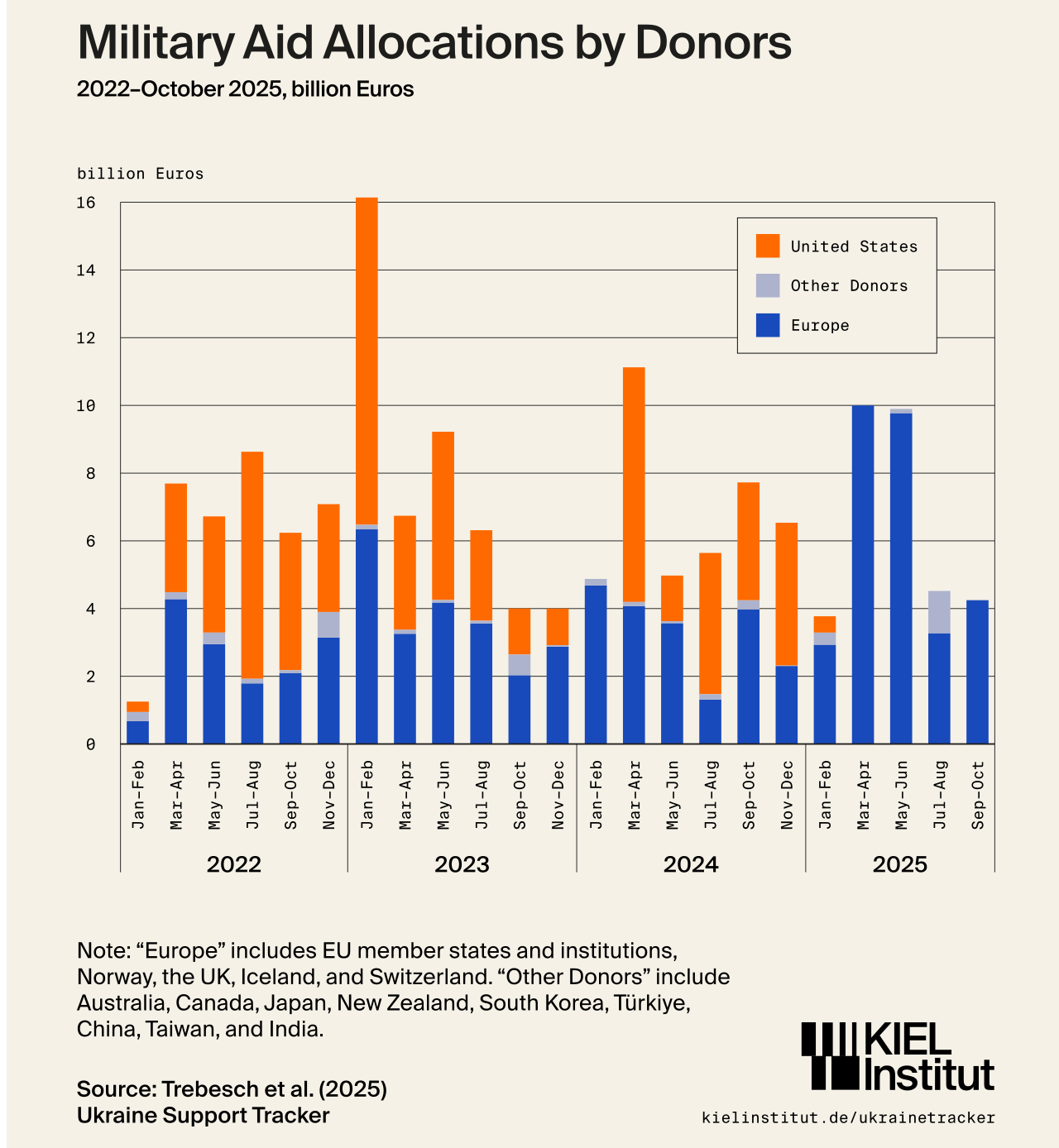
The US is not currently bankrolling Ukraine in the way it was in 2022–2024. Under Donald Trump, no new large aid packages have been approved, and support now largely consists of delivering previously authorised funds and equipment.
mopsi provided a link to data. Please at least look at it before making unsubstantiated statements. It clearly shows that the US has not contributed since the beginning of 2025, let alone 'bankrolled' it.
If you consider the topology, it is way less viable.
If you go through UAE (the narrow part) you are attempting to build a canal through mountains and desert.
Any other route (the non narrow parts) would just be 3-4x the length of the Suez Canal but through a desert, but since its not sea level the whole way, with locks (which means more water... again, desert), and at the end forces you through an even narrower strait at the end (Bab-el-Mandeb). The Houthis in Yemen have blasted Israeli-affiilated ships in that strait before, and they are Iran-backed.
Also, even if any of that were done: As ACOUP pointed out, the problem is not just the strait itself. Iran controls the entire eastern coast of the gulf and could harass ships from any location there. Even if ships could somehow bypass the strait, they'd still be in danger as long as they are in the gulf.
Essentially, Iran showed it can control most of the gulf if it wants to.
You can't cross the Arabian peninsula to the Red Sea either as there's also a mountain range on the west of it.
The only viable passage would be through the center of Oman (no mountain here) but that would be a gigantic canal. And that wouldn't really solve the issue, as the Iranians could easily block the canal as long as it is within reach of their drones and ballistic missile: you just need to hit one ship in the canal to effectively block it.
Or you could, like China did, build a massive railway from China directly to Teheran, thereby bypassing most of the maritime sanctions and maybe even transport oil directly to China:the 5 nations railway corridor https://fountainbridge.substack.com/p/china-iran-rail-corrid...
That's not a US specific strength though, anybody with the ability to strike someone with shorter range than theirs can do that. I.e. Netherland can destabilize South America through attacking Panama and its very unlikely that Netherlands will be bombed.
Sure, when US Brazil etc. are pissed off enough, Netherland can just TACO like the US did.
China and Russia can do the exactly same thing to Iran too and Iran won't be bombing Moscow or Beijing either.
It might demonstrate madness though, which in same cases can be useful.
This is an insane take. Why would Netherlands do this when America exists? And even if they didn't rest on their laurels and let America do it, they would not be able to establish a kill chain the way USA can, and so they would need American support. And even if they forewent the support, they would be denounced on the global stage and suffer massively economically. You are massively underestimating just how much liberty USA has to say YOLO and do whatever it wants.
Russia has established that it cannot in fact do this! That is why the two week special operation has gone on for so long.
China? It remains to be seen.
For now the best assumption is that USA is in a league of its own when it comes to imposing its will on other nations.
Maybe the Dutch are willing to risk it all to annoy the libs so they will elect and transfer all the power to a complete clown and attempt to make some money on the stock market and betting sites in the process.
I don't think parent is arguing that is a wise or prudent thing to do, but merely that violence is very much accessible to the state as an option. Just because it is not exercised with reckless abandon like, especially more recently, in the case of US, does not mean it suddenly does not exist.
<< For now the best assumption is that USA is in a league of its own when it comes to imposing its will on other nations.
You are wrong in general on this point. European countries in general have a long and exciting history of imposing its will upon others ( unilaterally and not ).
> For now the best assumption is that USA is in a league of its own when it comes to imposing its will on other nations.
It literally lost and wasted huge amount of resources in the process. Everyone else politely nodded until insulted too much, but otherwise ignored what USA wanted. When insulted, they exchanged some words while continuing to practically ignore what USA wants.
> For now the best assumption is that USA is in a league of its own when it comes to imposing its will on other nations.
I don't think that is a correct take away.
assuming that this ceasefire holds (big fucking if) it proves that the US is unable to defend it's self and allies against sustained drone attack.
Part of the reason why the middle east's US allies are allied is the implicit deal that they won't fuck with the oil supply, and the US will protect them against their enemies.
In the 90s, the USA would park a few carriers in the gulf and project complete air superiority. They can't do that anymore, and now needs land bases controlled by allies who the USA openly despises.
China doesn't need to bomb places to make its will felt. It's slowly and subtly built out bases over the south sea, effectively fortifying areas that are not chinas. They have also pretty much compromised most of the telecommunications infra through the various typhoons. (I've also heard rumours that intelligence agencies are leaking like a sieve as well.)
Part of the reason that WWI happened was because a massive military power tried to crush a "primitive" opponent, they fucked it up and demanded help from its allies. https://en.wikipedia.org/wiki/Battle_of_Cer this then dragged everyone into a massive fuckup.
It’s not the ME countries who are profiting, because they can’t export. So it’s a net loss. (Saudi and oman win a bit, but in no comparison to the iraq kuwait loss)
The winners are mostly: Russia, Iran itself and (margibally) the US. But mostly Russia.
The biggest winner is China. Countries/people who have any common sense will switch to solar, induction stoves (replacing LPG/LNG), batteries, electric vehicles (of all kinds). China is the only supplier of solar, batteries, EVs and all things electric with everyone else being a rounding error.
But that's what has changed. Even short term solar is becoming the obvious solution. Look at countries like Pakistan and their solar hyper growth.
Everybody thought it has to be western countries (mostly europe) switching to solar first. But west might actually be last to get off fossil because they can afford it and populist politics will force fossil. It's like burning fossil for nostalgia.
Ya, look at what happened in Nepal, poor access to oil via India, who imports it themselves, but lots of hydro potential. China being next door with an actual rail and truck connection, and cheap EVs.
The developing world has the potential to achieve developed living standards for a much cheaper price, while the west rots away catering to vested interests.
Russia has banned the export of gasoline starting April 1st, because hits on infrastructure by Ukraine are causing internal shortages. They may be profiting in some other way but it’s unlikely through major exports.
Over the past few months their oil facilities have been heavily attacked. It’s hard to believe they’re actually making a big profit from this in the short term.
The US isn’t winning. The owners of us oil companies may have won a little. Commodity gamblers won a lot by knowing what Trump would say and betting before he said it.
The US government and population have lost a lot of wealth.
US, in the past (eg - iraq) has shown that it can destabilize a region without any effects to the US, not even a mild price increase domestically. So this one is a big degradation from that earlier stance.
The $2m toll per strait crossing, at 120 ships a day, is going to pay dividends in perpetuity for them. Their economic situation is now actually better than it was pre-war.
The Islamic regem lost all its legitimacy in Jan. Even some loyalist where angry at them but they gain support of part of the people and found a reason to exist as the defender of the country.
They will survive and become stronger particularly if they get an economic lifeline out of this peace deal.
It helps the discussion if you would correctly restate what has been agreed. The first obvious mistake is that the US have agreed Iran can charge tax on ships passing the strait; at 32000 ships a year and a nominal $2M, that amounts to $64B alone, doubling their revenue from oil exports and making any foreign currency they like appear in their accounts.
And no, Europe and others definitely do not owe you any debt for this catastrophic war of choice (that still, they enabled! good luck flying there without them!). You will permanently lose many of the ME states to China.
There’s a good argument that European counties should be taking Trump to court and sanctioning him personally for the damage caused by a war he started.
Not sure which world you're in, but Iran has put forward a 10-point demand plan, and it looks like the US (or rather Trump) will likely accept all of them instead of getting stuck in a quagmire before elections.
Yeah, they did. Did you compare to their original 5 point plan? Their 10 point plan sounds like they've given up removing US bases, taxing Hormuz AND the safety of their proxy armies. No "right" to nuclear bombs (sorry "power stations"). No reparation payments. No removal of US bases.
Any agreement with Iran doesn't matter anyway, because Iran hasn't held up it's previous agreements, so there's no real long term point to any agreement. I wonder if they'll let the US clean up their nuclear stockpile and their centrifuges. That is the real question that matters to the west: does the US (or someone trustworthy) get to go in and remove that shit? Does the US (or someone trustworthy) get to go in and demine Hormuz?
(oh sorry, did propagandists claim Iran didn't mine Hormuz? Well, they lied. And we could point out that that is yet another islamist warcrime ... but what's the point? Frankly it's a pathetic warcrime compared to what they do to people in Iran itself, Syria and Yemen)
> According to state media, Iran will only accept the war’s conclusion once details are finalised in line with a 10-point peace plan reportedly submitted to the White House via Pakistani intermediaries.
> The list of 10 points, published by Iranianstate media, include a number of conditions the US has rejected in the past. The plan requires:
> The lifting of all primary and secondary sanctions on Iran.
> Continued Iranian control over the strait of Hormuz.
> US military withdrawal from the Middle East.
> An end to attacks on Iran and its allies.
> The release of frozen Iranian assets.
> A UN security council resolution making any deal binding.
> In the version released in Farsi, Iran also included the phrase “acceptance of enrichment” for its nuclear program. But for reasons that remain unclear, that phrase was missing in English versions shared by Iranian diplomats to journalists.
> I'm no fan of this administration but another way to look at things is that the US can essentially destabilize a region while facing mild commodity price increases.
Oil spiked over 40% at its peak and US gas prices are up 25-35%, and that's before things got to the point where there were "real" supply issues. I don't know how you can reasonably consider this "mild".
> Actually it shows that the US could eliminate the leadership at its leisure even if it can't hand select the replacements.
Everyone and their brother has known that the US can assassinate virtually any world leader if it really wants to. The question you haven't answered is: to what end?
> I'm also not sure the powers that be in the ME hate the rising oil prices.
Notwithstanding the fact that this situation only increases the attractiveness of oil alternatives, you're missing a few points, including:
1. If oil prices rise too much, too fast, it leads to demand destruction. Nobody captures the higher profits for long because the global economy falls into recession if oil stays above a certain price point.
2. Price stability is just as important as price.
3. Significant long-term damage was done to oil infrastructure and Iran demonstrated how easily infrastructure can be effectively targeted despite all of the advantages its neighbors have in terms of American support, American defense technology, etc.
Your comment also doesn't consider the geopolitical costs of this "excursion". The administration's actions have further alienated America's strongest allies (except for Israel) and added fuel to the "America is undependable" fire. This is good news for China:
> China surpassed the United States in global leadership approval ratings last year, as Donald Trump's second administration began its term in earnest, according to a new Gallup survey.
> The polling firm reported Thursday that the median global approval rating for Chinese leadership stood at 36% in its 2025 world survey, exceeding the 31% recorded for U.S. leadership. It marked the first time in 20 years that China's approval rating topped that of the United States by more than 5 percentage points.
If we're being honest, there are no winners in war but since we live in a world that likes to have winners and losers, a loss for the US is a victory for Iran.
Not only has Iran managed to survive being battered by the most powerful military in history, it has:
1. Created a global energy and economic crisis.
2. Effectively demonstrated that it can control the Strait of Hormuz even without much naval and air firepower. In doing so, it showed that the US Navy is not capable of controlling the seas anywhere and anytime.
3. Caused the US and its allies to spend billions of dollars worth of advanced weapons systems (many of which were already in short supply) to defend against much cheaper drones and missiles.
4. Incited Trump to lash out at the European countries that have historically been America's biggest allies, accelerating the trend of America's now possibly irreparably damaged relationships with these countries.
5. Baited Trump into publicly and belligerently positioning the US as a hostile state willing to threaten war crimes/genocide to get its way.
A lot of Iran’s victory simply revolves around Trump being so incompetent. But then again any president with half a brain wouldn’t touch a war with Iran given our negative experience in the region fighting much weaker countries.
I think I broadly agree with you. Even if we accept the premise that it is not a win for anyone in a war ( there are counters here, but lets say that we accept it ), the reputational damage to US is hard to be overstated. I am not entirely certain some of it will be salvaged. That is how bad it is.
I am not a fan of Trump, but I was mostly ambivalent about most of his escapades. He clearly got really lucky with Venezuela and it went to his head.
> (...) another way to look at things is that the US can essentially destabilize a region while facing mild commodity price increases.
I'm afraid you are yet to experience the real impact of this war. The actual effect of closing the strait hasn't hit your wallet yet. It's a repeat of the same old tariff bullshit.
Also, Iran did inflicted heavy damage on some of the infrastructure of US's allies. You will start to feel that in a few months.
The only party that clearly stood to benefit from this event was Putin's regime. Orban is not the only vassal at his command.
You weren't paying attention because that's what the US does since decades... Just now it impacts Western countries directly (Ukraine and Iran come to mind)
I think you're mostly right, except maybe a bit misinformed on #1. The younger Khamenei is, according to recent reports, in a very unstable condition, has likely never actually had an input on the leadership of Iran so far, and his future state is uncertain.
So I think there will be another leader elected soon.
> So I think there will be another leader elected soon.
That alone is another clear sign of Iran's ruling regime emerging as the clear victor. Not only there was no regime change but also their primary regional and global antagonists tried their hardest and completely failed to overthrow them.
Moreover, some neighboring countries who were in the US sphere of influence were very quick to fold and remove themselves from the conflict, while others saw their primary economy attacked by Iran and helplessly so.
Forget about Iranian regime's internal opposition. So did the US.
Is there any question on who emerged the clear winner?
1. A power struggle is more likely than an election. Even if an election, it would be a bit Putinesque considering the IRGC has killed 30k protesters this year, that likely included any viable opposition leaders.
2. Only Qatar, and it is speculated because it was one of 3 countries in the region not intimated by the US about the attack, and they aren't very happy about that.
This is mostly true, but I have to push back against the 30k number. That's a number that only the US regime has been touting. HRANA has verified about 7000.
> I think you're mostly right, except maybe a bit misinformed on #1. The younger Khamenei is, according to recent reports, in a very unstable condition, has likely never actually had an input on the leadership of Iran so far, and his future state is uncertain.
> So I think there will be another leader elected soon.
What does that have to do with anything? The USA (my country, sadly) provoked a far smaller nation and was proved incapable of dominance.
Trump will claim victory, but it's not what they thought they'd get.
What the eff do you even mean? I'm not trying to be inquisitive. I'm pointing out a very specific fault. You're trying to reframe my point and you're full of it.
> What does that have to do with anything?
That's not an actual question. That's me saying "wtf are you talking about".
I'd say more like a loss for the US than a win for Iran.
> 4. Showed everyone in the ME and the world that if anyone messes with them they’ll close the straight. Then gas prices go up. Then your own domestic pop gets pissed. Then your chances of re-election drop.
Everyone knew from the beginning that closing the strait was something Iran would do. But it is current US government that is either inept or too smart for their own good and thought with US producing surplus oil for domestic use, it will not impact them. They didn't care for the consequences and it came back to bite them.
Also, wasn't it that even if the war was stop/ceasefire oil prices will take a long time to recover? If that is true the domestic pop getting pissed might be true even with this ceasefire and it will hurt the current government in their upcoming elections.
> 3. Reminded the anti regime population that they’re not going anywhere and that the US can’t help them.
More like galvanized people against a common enemy. Regime is going to come down hard on the protestors than ever before and some might find it easier to blame the power which claimed to deliver the regime change. Then Americans will talk about how Iranians hate their way of life and the attack was justified.
> thought with US producing surplus oil for domestic use
I have to assume that at least someone in the room was well aware that all oil is not created equal and that US refineries were designed from the beginning for Venezuelan and similar oil rather than US oil.
That's why I said either inept or too smart for their own good because closing of the strait was a real threat before the war and was ignored, leading to the tweet on Easter.
Even if US refineries were designed for US oil to keep domestic prices low one would have to introduce export restrictions because oil is a global commondity. Big oil will not be happy about that and it seems they have a great influence over the respublican party and Trump.
Nationalization doesn't define who is in charge though. You can have the state taking over industry, you can also have industry taking over the state. Both ultimately lead to nationalization of the industry.
Still looking at the details, but this morning, one of the biggest French newspapers was basically headlining (a slightly more polite version of) TACO.
Not a good image for the US around the world, including its (former?) allies, I guess.
One should never draw a redline they aren't willing to cross. Trump of all people should know this, he gave Obama shit for years over the uninforced redline with Syria over chemical weapon use.
To Trump, when someone else does something, it's worthy of reproach, but when Trump himself does it, it's the cleverest 4D chess anyone could ever imagine.
A more fundamental aspect of his character is that everything his enemies does is bad and stupid and everything he does is good and genius.
So if Obama allows red lines to be crossed, it's totally different. Trump has a long history of bluster and hyperbole and - look - we re-elected him so I guess it can be a winning strategy.
Or it was. Now that people are calling his bluff on tariffs and genocide, there isn't so much winning.
This war (not the ceasefire) is basically a loss for the USA. Many people don't yet grasp the scale of the reputational, economic, and power damage that has occurred and will continue to occur.
Just the attack on data centers has caused certain conversations in my circles that basically comes to down to some guys will try to get off of foreign clouds and into local hosting in their own countries (most seems keen for co-location hosting because of the static ip ranges & other admin sugar and reliable power; not concerned about hardware pricing as the hardware is less than 10% of the equation). All thanks to a couple attacks on data centers that we are not even hosting on.
> 3. Reminded the anti regime population that they’re not going anywhere and that the US can’t help them.
More like: Reminded the anti regime population that US has no interest to help them and will happily kill all Iranians and proudly destroy all of civil infrastructure.
> 5. Destabilised the whole region costing the ME lots and lots of money.
In this case, the destabilization is firmly the fault of USA and Israel.
It's very hard for me to see this war (regardless of final outcome) as anything other than a massive strategic loss for the USA. The US has spent a stunning amount of materiel and political capital to achieve nothing of lasting benefit to themselves, and have killed thousands while further destabilising and impoverishing the region. A catastrophic outcome.
It's absolutely possible for both sides in a major conflict to lose, and they've managed to do so in this case.
I disagree. Iran was about to lose. If this ceasefire had not happened, the US and Israel would bomb all of Iran's electricity and fuel facilities. That's what was supposed to happen today, and is what forced Iran to the negotiating table with an hour to spare.
Without electricity, there is no modern life. There is no ability to communicate, pay salaries, run a business, have running water, etc. Without fuel, there are no logistics; there is no capability to transport an army. Nor is there an ability to transport food, people will starve; it would cause an enormous civilian crisis, and this would cause massive riots bigger than the ones seen in January.
The Iranian government would have no ability to coordinate a response, and Iran would collapse within a week. The country would devolve into chaos, into paramilitary factions, and a civil war would start, similar to in Syria.
The US and Israel have been sitting on this the entire time. They don't want to do it, because it would cause near permanent economic damage to Iran.
Once Iran showed it had no ability to prevent the US/Israel from doing a indiscriminate bombing campaign, it was clear the US and Israel could always win this war through this outcome.
It never had any ability to prevent an indiscriminate bombing campaign, and never did. And nobody ever thought otherwise.
It only ever had to prove it could keep the strait closed. Which it did. And now the americans are going away, and they can get back to hanging students from cranes.
The USA has failed to achieve any of its strategic goals, and is going home, defeated.
The conflict is far from over, this ceasefire is unsustainable as neither side wants to agree to the demands of the other.
A ceasefire mostly benefits the US, since it can bring in more military assets across the globe. Ships and troops are still weeks away from arriving & being able to participate in combat operations.
A negotiated settlement is preferable to total destruction of the Iranian economy, and large destruction in the middle east, by all parties involved.
I expect the conflict to resume after two weeks, or later this year, after midterms.
…except very few died. The Iranian and US casualties and entire ME casualties since the operation started combined are less than 15% of the Iranian citizens slaughtered a month before this all started.
Do we not care about deaths anymore? Avoiding war and death is a win for everyone.
They did not manage to bomb Germany, North Korea, or North Vietnam into submission and they tried for years. Winning through bombing alone has never worked.
No, it would achieve the three primary goals of this conflict.
It would cause catastrophic economic damage to Iran, and given how politically unstable Iran currently is (millions of people rioted earlier this year), the regime would not survive the oncoming civil unrest.
It would be a humanitarian disaster, but from the US/Israel's point of view, it would be a victory. An Iran with no electricity has no capacity for industry, and has no ability to manufacture missiles, drones, or have a nuclear program.
Without ability to manufacture missiles, Iran would be unable coerce people to buy into it's Hormuz transit toll system, and the strait would reopen.
This weakened Iran would have no ability to produce nukes, close the strait, and make missiles; for at least a decade while they recover economically.
> This weakened Iran would have no ability […], close the strait, […]
Here is where we disagree. And i think this is the only point which matters.
I agree with you that the US always had the ability to destroy Iranian civilian infrastructure. I agree with you that doing so would cause catastrophic economic damage, civilian unrest, regime overthrow etc. It would seriously disrupt their nuclear program for sure.
What it wouldn’t do is reopen the strait. As long as some ships pay the toll those monies can be used to pay the “warfighters” and their weapons. It is relatively cheap to do so. Ukraine demonstrated this with their unmanned surface vessels. This they can do even if the whole hinterland of Iran is in flames and turmoil.
In fact the more their economy collapses the more lucrative this coastal piracy “business” relatively to other opportunities becomes. People who “before the bombing” had better things to do will find that shaking down foreign ships is still doable “after the bombing”. Some of it will be out of ideology and hate for sure, destroying all the civilian infra of a country tends to whip up emotions in people. But fundamentally they can keep doing it because it is a business which pays.
And regime overthrow won’t help with this either. In the absence of a strong central coordinating force you might get multiple separate pirate outfits camping at different parts of the coast trying to take tolls. That obviously wouldn’t improve their economic success, but would increase chaos and hinder transportation even more.
In short while the USA could destroy Iran as a nation, doing so would not eliminate the threat to shipping in the region.
Iran's "toll booth" only functions because they shoot missiles at ships that don't pay up. If they didn't shoot missiles, nobody would pay. They have no legal ability to do this; the strait is split between Iranian and Omani territorial waters. Iran does not have legal control over Omani waters. Actually enforcing their "toll" means firing missiles at ships in Omani waters who don't pay. It's a combination of piracy, terrorism, and an act of war (violation of Omani sovereignty).
This situation is unacceptable for every other Gulf country. It may not be dealt with in the coming weeks, but will be addressed in the coming months, in a similar fashion to how Somali piracy was neutralized.
Also, a neutered Iran would not have the capability of producing anti-ship missiles, which is the primary enforcement mechanic of this toll.
"Without ability to manufacture missiles, Iran would be unable coerce people to buy into it's Hormuz transit toll system, and the strait would reopen."
You don't need missiles to keep Hormuz closed. Cheap drones, naval mines and such are enough, and those don't require that much production capabilities, especially if you get some help from Russia. It's enough to hit a ship every now and then, which keeps the insurers away.
Even without any infrastructure IRGC could wage a guerrilla war for a long time.
In an industrial collapse scenario people in Iran, including IRGC, might have something more urgent than antagonizing ships. Things like subsistence farming.
That's not something I would cheer for. For what it's worth, this did not Germany, Japan, North Korea or Vietnam to collapse. What makes this time different?
Iran is already teetering on the brink of collapse, the country is suffering from a decade-long economic crisis, and massive riots nearly tore apart the country earlier this year.
It is highly urban country, where 75% of people live in modern cities. Cities cannot survive without a constant influx of food and water, both of which require electricity and fuel to be delivered. In the previous conflicts you mentioned over 50 years ago, Japan, North Korea and Vietnam had large rural populations that were less affected by access to electricity and fuel.
Also, consider how much of modern life now relies on vehicles and computers, which would be disrupted immediately if this conflict continues.
Regarding Germany, the allies did not focus on destroying German electrical infrastructure, they actually didn't consider it as a priority target. However, post-war analysis determined that if they performed a targeted bombing campaign on Germany's electrical generation, it would have significantly hampered Germany's industrial capacity, and pushed the war to a close months sooner.
> Iran is already teetering on the brink of collapse
"We only have to kick in the door and the whole rotten structure will come crashing down"
- Adolf Hitler about invading the Soviet Union.
Again, I must reiterate my point: terror bombing has never ended a war. Post-war analysis also confirms that despite a very costly strategic bombing campaign, Germany tripled its production. Things fell apart when they lost men, ground, harvests and alloy mines to the Red Army. The war ended with the Soviets in Berlin, firing howitzers at government headquarters with open sights.
Perhaps the strategy that failed every single time so far will work if we ramp up the cruelty a few notches, but that's not a possibility I am excited about.
It's still a victory. It postpones Iran's nuclear and missile capabilities by a decade, and kicks the can down the road so another administration can come back and clean up the mess again.
Putting aside the fact that the humanitarian disaster you envision would not produce the simple result you expect, it's quite disturbing that you have completely glossed over the fact that destroying Iran's ability to produce electricity is a war crime.
Committing an act of genocide against a country of 90+ million people would be the death of the US as we know it.
Ah yes, a comment from the morality police. According to international law, if the electrical grid directly enables Iran's military, then it is a valid military target. In every major conflict since WWII, electrical infrastructure has been targeted. This includes WWII, the Korean war, Vietnam War, Iran-Iraq War, the Gulf wars, 2003 Iraq War, and the Russo-Ukrainian War.
So no, it's not automatically a war crime, it's a case-by-case basis.
And claims of "genocide" from are laughable and ludicrous, the target is the IRGC, and regime change. If they wanted genocide there are far more effective ways to do so.
Russia bombing civilian infrastructure does not make it "not a war crime". The fact is, USA and Israel did committed war crimes here and planned to commit more of them.
And yes, according to international law. No, you do not get to bomb desalination plants, eletricity plans, universities, hospitals, bridges and schools and claim "it is not a war crime because soldiers in area exist".
It is not possible to take your moral high-ground "war crime" argument seriously, when Iran is doing the exact things you are accusing Israel of doing.
This is a textbook definition of terrorism. That the military uses the civilian infrastructure is a justification that not even the US tried to use. This is pure terror bombing, and they admitted as much.
> According to international law, if the electrical grid directly enables Iran's military, then it is a valid military target.
This is not what international law states. The Geneva Conventions forbid direct attacks on civilian assets. Where assets are dual-use, the principle of proportionality applies and your intent cannot be to cause suffering, destroy civilian morale, etc.
I think anyone with an ounce of human decency and who isn't playing keyboard warrior saw Trump's threat to destroy "a whole civilization" for what it was, which is why so many military and legal scholars were disturbed by it.
For those who actually care about what the law says instead of beating their chests:
Well yes, if cruelty is the goal, bombing civilians is cruel.
If I'm not mistaken, the Obama administration was about to accomplish every single one of those goals with a treaty, which the Trump administration cancelled. Bombing a country into accepting terms that they had already agreed to is not that impressive.
Do not underestimate the effects of modern precision bombing, the technology moved forward (especially if we compare it with II. world war). Today it's much easier to destroy any kind of infrastructure, power plants, bridges, dams, water preparation facilities, waste treatment, cement, steel production, food silos, fuel storage, vehicle manufacturing, etc.
This is very important because, population in cities is much more dependent on infrastructure, than rural population. Rural population is mostly self sufficient. Over 60% of Iranians live today in cities, but under 20% of Vietnamese lived in cities at the time of Vietnam war. Vietnam was also strongly supported by China, with transportation using Laos and Cambodian.
So a large scale bombing of all Iranian infrastructure would probable not cause the fall of the regime, because they have the guns and can take anything they want, but the suffering and famine of Iranian people would be enormous.
Sometimes large scale bombing causes submission, for example fire-bombing of Japanese cities (atomic bombing of Hiroshima and Nagasaki was in the scale of destruction and loss of life comparable to Tokyo fire bombing, only much cheaper in the number of airplanes).
My point is that you can't bomb a country into submission. You can use strategic air power in addition to other methods, but the bombing alone was proven again and again to fail. More often than not, it hardens the enemy's resolve.
Bombing Britain failed. Bombing Germany failed (except for dragging the Luftwaffe into a war of attrition). Bombing Japan failed on its own until Japan had no navy left afloat, and the Russians savaged their army in China. The bomb accelerated a victory achieved through other means.
In Korea, Americans levelled cities and infrastructure until there was nothing left to bomb. That did not win the war.
In Vietnam, Linebacker failed. Linebacker II bought slightly more favourable terms for the US in negotiations, but in the end, North Vietnam won.
Even the Desert Storm curbstomp would not have worked without boots on the ground.
Yes bombing of Japan was a factor in surrender, but not the only one. Destruction of much industry, destruction of navy, all their allies were defeated. There were preparations for invasion of Japan or continuous atomic bombing, if Japan would not surrender.
"Two more Fat Man assemblies were readied and scheduled to leave Kirtland Field for Tinian on 11 and 14 August"
"At Los Alamos Laboratory, technicians worked 24 hours straight to cast another plutonium core. Although cast, it still needed to be pressed and coated, which would take until 16 August. Therefore, it could have been ready for use on 19 August."
The rate of bomb production was one of the Manhattan Project’s most closely guarded secrets. Expected rate of production by General Groves:
"The production rate of 3 bombs per month in August was expected to rise to 5 bombs per month in November, and 7 bombs per month in December. In 1946, it could rise much higher."
"In Vietnam, the same problem complicated any effort at industrial bombing: the factories that supplied the North Vietnamese forces (both the regular PAVN and irregular NLF) were in China and especially the USSR. Moreover the population was not broadly dependent on centralized utilities (like electricity) which could be bombed."
The article tries to apply lesson from past bombing campaigns to war in Ukraine, but this don't apply because Russia could not establish air supremacy over Ukraine and could not apply large scale heavy bombing. And I hope that they never will...
> The US and Israel have been sitting on this the entire time. They don't want to do it, because it would cause near permanent economic damage to Iran.
That is such an incredible interpretation of the situation that basically requires you to ignore basically every economic problem being faced from this insanity currently and in the near future.
Sure, the US an Israel were just "too concerned" about the Iranian economy to do war crimes.
The Iranian military is very decentralised and designed specifically with American capabilities in mind. So am not sure they would collapse. And a defending force is far less dependent on logistics in the short term. Also, Iran has a culture of sacrifice.
Iran and the US exist in a state of equilibrium of opposite strategies. The US is unwilling to risk its troops and sees sacrifice as weakness but otherwise applies maximal pressure. And Iran is willing to sacrifice its citizens and sees that as noble. And outside of a black swan event there is little hope of change.
Each side sees its enemies greatest military strength as a moral weakness and will keep fighting. Whilst conversely believing that sacrifice/maximal remote force may someday work. Iranians are not going to pivot because their culture has been forged as a response to exactly this kind of pressure. Nor will America suddenly see the sacrifices of thousands of it's men as virtuous. So things probably just revert back to the same equilibrium.
The point is that America blowing up power plants and Iran absorbing casualties is just an extension of the status quo.
If the US ended up damaging power plans and desalination plants, that would mark a clear inflection point in the number of "friends" the US has militarily, economically, and politically. Sure, Israel would still be a big fan, and maybe Saudi Arabia, but otherwise the US would become a pariah.
It would be damaging to Iran and potentially hundreds of thousands or millions would die.
That's a lot of blood debts.
There is no way the US would walk away from that situation into a better outcome.
Hundreds of regime leadership is gone. Massive destruction of infrastructure. Bombed all their neighbors who weren’t even at war with them. Pushed those same neighbors into closer partnership with Israel and the US.
This would make sense if the regime command structure had apparently not designed itself for this exact type of conflict.
They were in a fight, took losses, and made significant gains.
They proved their planning was correct, that the distributed nature of their power grid was correct, that they are able to project force and genuinely destabilize the strait.
Things have been proven that were previously uncertain, and they have not been proven in America’s favour.
Crucially America’s ability to defend its allies was tested and found wanting. The entire conflict was of unit economics, in that a cheap 30k drone beat out billion dollar investments.
America also spent the better part of this administration alienating themselves from the one allied nation with extensive drone combat experience.
Admittedly, this is the interesting part. Ukraine via its leader apparently did try to reach US in exchange for money, but, and there stories get confused, was ignored. I have to wonder if Trump has some actual fixed winners table in his mind ( because he does not seem to follow the most optimal path ).
None of those things matter if they survive and control the straight, which seems to be the situation. The toll revenue will be enough to rebuild several times over. They have proven that they can absolutely crush the gulf states with missiles and drones.
I think the fact that Trump accepted their 10-point plan as the basis for negotiation, instead of them accepting the American 15-point plan, makes it obvious this is America taking the loss.
And they haven’t come close to “crushing the gulf states”. Lobbing a middle at the oil facility is not “crushing”, it’s harassment. If anything the gulf states have decided to not retaliate themselves, but if they did it would be even worse for Iran.
Trump did not “accept” the 10 point plan. Not even close. It’s simply a list of demands from Iran, nobody has agreed to anything.
Real world events are conditional. Would you prefer I talk in absolutes?
Defacto Iran still controls the strait, as they have since the start of the war. If they start letting the ships through with no toll, I think that would indicate a tactical loss but strategic draw for Iran (well, the IRGC). If they don’t, it’s a strategic win. We’ll find out I guess.
The small gulf states are incredibly fragile because of their water supply. Major disruption to their power or desalinisation directly renders them largely uninhabitable.
You’re misquoting me on the 10 point plan. He accepted it as the _basis for negotiation_. Here’s direct quote from him on Truth Social:
“We received a 10 point proposal from Iran, and believe it is a workable basis on which to negotiate”
Lining up multiple low probability events and talking like it’s certainty isn’t that helpful to understanding the conflict.
Iran does not “control” the strait any more than neighbor controls my front door because he threatened to stop me from using it. If the US or other naval power tried to pass it would have no issue.
Have you noticed when the Houthis did the same thing (fire on ships) last year the tone was very different? Many people noticed.
Accepting something as a “basis for negotiation” means nothing. During the Korean War the US accepted a term forcing them to leave the Korean Peninsula when peace talks started and last I checked the US is still there.
> Iran does not “control” the strait any more than neighbor controls my front door because he threatened to stop me from using it. If the US or other naval power tried to pass it would have no issue
If your neighbour threatened to shoot anyone attempting to use your front door, and followed through on their threat a few times, and now no one uses your front door, I would say they control it.
Well the “expert” analysis you mentioned said the world would grind to a halt last month but that didn’t happen did it?
India and Pakistan have been running the “closure” several times with escorts, successfully. All it would take a is a naval coalition of 3-4 countries and the strait is effectively open - and no toll.
Iran is in a far worse position now than it was a month ago (and it was in a bad position back then). It’s a matter of time before Iran is no longer able to project any force in the gulf. And all the countries in the Middle East will be happy it happened.
Yup, and it's a demonstration that the US is unable to just impose its will wherever it wants, making the US look weaker.
Failure all around.
But no doubt Trump and his people will tell the world what an amazing success the whole thing was, and how they exceeded all their goals, whatever those goals might have been.
More loss for US, as in customary US not winning fast is functionally the same as losing.
Heavy weight boxing a teen it should have brained in round 1.
Teen lands a few punches back is embarrassing.
Teen slapping heavy weights protectorates more embarrassing.
Teen surviving week 4 is like heavy weight failing to brain teen by round 7.
At this point it's looking like we're going to round 10 TKO, whoever "wins", US loses. People still going to wank over if US wins on TKO because muh K:D ratio or something, but real signal is teen's strategy was to survive hits and ultimately 10000s of heavy weight hits weren't haymaker strong enough to brain a teen. At >2% of GDP of PRC, Iran is basically teen/toddler territory that drew down significant % of US active force and munition stockpiles, so there's also layer of US losing more based on relative effort expended.
To China, the conflict is a clear demonstration of the impotency of the US war machine. Before this "military operation", one could imagine the US defending Taiwan.
Now, it's a laughable thought. It couldn't even if it wanted to.
Remember that the defender has home team advantage. That’s precisely what you see happening both in Iran and Ukraine. That advantage exists with Taiwan. There’s a reason that China hasn’t made a move in all these years, and the US is only one part of that equation.
Homefield advantage is relative, between Ukraine - Iran - Gaza, Taiwan is closer to Gaza, which is to say not much after mitigating outside spoilers. Maybe less than Gaza vs force disparity involved. US is/was one part of equation, but big part of equation.
There will be a 2 week ceasefire, western countries will move ships out of the straight, the Saudis will reroute oil, the 10 point plan is idiotic and the US will have an easy excuse to resume bombing them.
I agree with you that this is just temporary, but for entirely different reasons. I think that stock market fluctuations are making some people very very rich. It's the same game as they did with the tariffs on/off every week and it's not over yet.
I don't think we know if the ceasefire will hold or if it's another attempt by trump at strategic delay/deception, but remember that the strait carries a lot more than oil and those things cannot be transported via a pipeline.
My assumption is that, by now, Trump just wants to save face and move on to an easier target, one that can't strike back. He's been preparing the US opinion for Cuba.
So I wouldn't be surprised if negotiations just... stopped, without anything happening. Pretty much what happened, if I understand correctly, to the economic negotiations with Japan, EU, Canada, Mexico and anybody else regarding US import taxes.
> And? Reduced capacity for awhile raises prices, the Saudis can sit on some oil and have the US get rid of their geopolitical and economic rival.
That pipeline is a strike away from being out for months, if not years.
> Because the Iranian 10 point plan is so ridiculous even Trump isn't dumb enough to take it.
The whole situation is ridiculous, and Trump is overtly desperate to stop the nightmare at any cost. Calling something ridiculous is no argument, particularly when we are living in a timeline where stupidity reigns.
Ok. This is getting silly and on par with 'the straight is open; it is only closed, because Iran is blocking it' quip from Hegseth. Tensions are high, because there are trapped hips AND there is no viable alternative.
It's a war, everybody loses, but given that the US started this with the explicit goal of regime change and has manifestly failed to accomplish this, it's a victory by default for Iran.
Although it wouldn't surprise me if the final deal includes Khameini Jr stepping down and being replaced by somebody with a more palatable last name.
Winning is not the absence of anything negative. Winning is emerging in a stronger position than before.
Yes the US started the conflict for reasons which are unclear. Yes a lot of lives were lost, and a lot of infrastructure destroyed.
Because the US goals are so murky it's hard to determine their standard for "winning". Certainly no one (myself included) is a fan of the Iranian regime. But that hasn't changed. The nuclear threat is unchanged. (A threat which only exists because of Trumps actions in his first term.)
What we have seen is the threat of the strait closing move from the theoretical to practical. We've seen the impact that has on the global sentiment. Iran has a card to play, and they played it, and now we all understand what it means. That strengthens their position.
Israel also ends up weaker here. The nuclear threat is unchanged. But the deaths in Iran will fuel enlistment in anti-Israel terrorist organizations for another generation.
America has lost some global prestige. (Not for the first time recently.) They've shown that they are powerless to open the strait by force.
"Winning" is a loaded term. But so far they have prevented the US from achieving their goals (if they even had any). Lots of countries declined the invitation to join in. Iran is now diplomatically stronger than before. The US and Israel are weaker. Call it whatever you like.
> Israel also ends up weaker here. The nuclear threat is unchanged. But the deaths in Iran will fuel enlistment in anti-Israel terrorist organizations for another generation.
I agree with everything else you wrote, but I'm not sure that this is considered a loss by Israel's current government.
1. Israel is used to having enemies all over the world, so by now, the population doesn't care all that much.
2. The Likoud and its far-right alliance actually needs enemies to remain in power.
Also, any reduction in the number of missiles that Iran can launch at Israel, and any reduction in the number of AA armament that prevents Israel from bombing Iran again is good for Israel.
Where Israel will feel the loss is the 2M$ levy, because this means that Iran will rearm that much faster.
True, if the presence of active terrorist organizations is beneficial then this is a win.
Politically it might suit Israel to have overt enemies. I'm not sure it's necessarily advantageous to the population, but that probably doesn't matter.
I suspect one clear outcome is that Iran now completely understands the importance of cheap, effective, munitions (drones and missiles) and so will likely build those up quickly. That might affect munitions targeted at Israel.
> I suspect one clear outcome is that Iran now completely understands the importance of cheap, effective, munitions (drones and missiles) and so will likely build those up quickly. That might affect munitions targeted at Israel.
I think that this has affected Israel for decades by now. See all the rocket factories in South Lebanon or Gaza. I imagine that this is the reason for which Israel demonstrated a few years ago prototypes of laser-based anti-missiles. I don't know if they will could work against drones, but I'd be very, very surprised if there weren't a dozen Israeli startups currently competing to come up with cheap anti-drone countermeasures.
I don’t think Opus and Sonnet are significantly better than Gemini or ChatGPT. Am I missing something?
It looks to me that Anthropic is one or two Gemmas away from a lot of people using Opus for 20% of hard use cases and letting on-device LLM rip through the code base on a Mac Mini or Studio and OpenCode.
Once Claude Code is not the only game in town and Cowork is made redundant by Google pulling their finger out on integration with Workspace, what else is there for Anthropic?
On-device agentic use is orders of magnitude harder than simple chatting (which is still slow for SOTA), it uses up a huge amount of context and tokens on reading code and reasoning through it. It's sort of viable if you just set it to work overnight on some completely vibe-coded stuff, but that has very middling results. Giving feedback to the model interactively is completely out of the question.
Where open models can make a difference for agentic use is with third-party inference at scale, which can actually be fast enough for reasonable workflows.
How so? Opus and Sonnet are frontier models which cannot easily be replicated. Compute has real physical constraints which require appropriate procurement at this scale. At least those two points seem like pretty strong moats against the majority of companies.
You don't need to "replicate" Opus and Sonnet, you just need to match their overall performance at lower cost. That's been absolutely doable so far, with a steadily decreasing lag time.
That's a fair response. But I'm not aware of any metrics supporting the point that the lag time is decreasing. The discourse I've seen has more focused on the ways Claude/OpenAI/Google have pulled away from the rest of the pack.
To be clear, I accept you might be right, but I think the crux is whether lag time is increasing, steady or growing.
You're right and the your reasoning is great. Anthropic should fold and give up their $30 billion ARR just announced in the OP. Shut it all down, no moat here.
Wow the sceptics really came out in force for this one.
I’m currently using Gemini to research components for a remote controlled plane. I have the frame of the plane and now need to buy correctly specced servo motors, an engine, battery, etc etc. It has saved me so much time and educated me tremendously on how the different components interact and the options available.
If I could just press “buy” from within Gemini and pay via Google Pay (or better still, Apple Pay) I’d do it in a heartbeat.
It's not even just that- with component selection you have a handful of datasheets that give you (ideally) fairly truthful information about the device. You can rather deterministically look at these and compare them.
Regular consumer products? Good fucking luck. Anywhere an LLM pulls from is probably going to be mostly SEO'd listicles.


reply