Oh thanks! That'll be great to see :). Edit: feel free to drop a link here or send to me when it's ready, I'd love to read it! My contact info is in my blog!
I have this specific keyboard, "POP Icon Keys" (not to be confused with "POP Keys"). It's fine. I can confirm that it doesn't fold and is not particularly compact.
I love the talk! But I do feel something critical is missing. You can not talk about semi-conductors without at least mentioning Walter Schottky (but I think that doesn't fit the narrative because he was a German).
The theories from before WWII of Walter Schottky were indeed an important step in the development of semiconductor physics.
Besides Schottky there are a great number of other people who had critical contributions towards the development of semiconductor devices and who are not mentioned in the very short summary from the video.
For instance, Julius Edgar Lilienfeld had invented before WWII 2 kinds of field-effect transistors: metal-semiconductor FETs and depletion-mode MOSFETs. But before WWII making such devices was not reproducible, because the available semiconductor materials were too impure.
Nevertheless, the Bell team searching for methods to make semiconductor triodes was aware of these patents and they were stimulated by them to find alternative structures that worked.
The work of the team that discovered the point-contact transistor would have been completely impossible without the techniques developed during the war by some of their colleagues, e.g. by Russell Shoemaker Ohl, for making pure germanium and silicon and diodes using these materials. (During the war, Ohl has also invented the silicon solar cell, as a byproduct of the work on radar diodes.)
Thank you! And Schottky was a good catch, and there are a few European scientists I’m not paying appropriate homage to, for sure. I had to cut a lot to get this down to a 30 minute talk, to native Kazakh speakers, so I definitely tightened up a lot. I will go back and read on Schottky again.
Side-note, for those interested, I want to point out a new CMS: https://pureblog.org/
Not a SSG in the strict sense, but it generates md files and serves those on the fly.
There is a WordPress migrate-tool that worked flawlessly.
It should also be mentioned, Linux Load Average is a complex beast[1]. However, a general rule of thumb that works for most environments is:
You always want the load average to be less than the total number of CPU cores. If higher, you're likely experiencing a lot of waits and context switching.
On Linux this is not true, on an IO heavy system - with lots of synchronous I/Os done concurrently by many threads - your load average may be well over the number of CPUs, without having a CPU shortage. Say, you have 16 CPUs, load avg is 20, but only 10 threads out of 20 are in Runnable (R) mode on average, and the other 10 are in Uninterruptible sleep (D) mode. You don't have a CPU shortage in this case.
Note that synchronous I/O completion checks for previously submitted asynchronous I/Os (both with libaio and io_uring) do not contribute to system load as they sleep in the interruptible sleep (S) mode.
That's why I tend to break down the system load (demand) by the sleep type, system call and wchan/kernel stack location when possible. I've written about the techniques and one extreme scenario ("system load in thousands, little CPU usage") here:
The proper way is to have a idea of what it normally is before you need to troubleshoot issues.
What is a 'good load' depends on the application and how it works. Some servers something close to 0 is a good thing. Other servers a 10 or lower means something is seriously wrong.
Of course if you don't know what is a 'good' number or you are trying to optimize a application and looking for bottlenecks then it is time to reach for different tools.
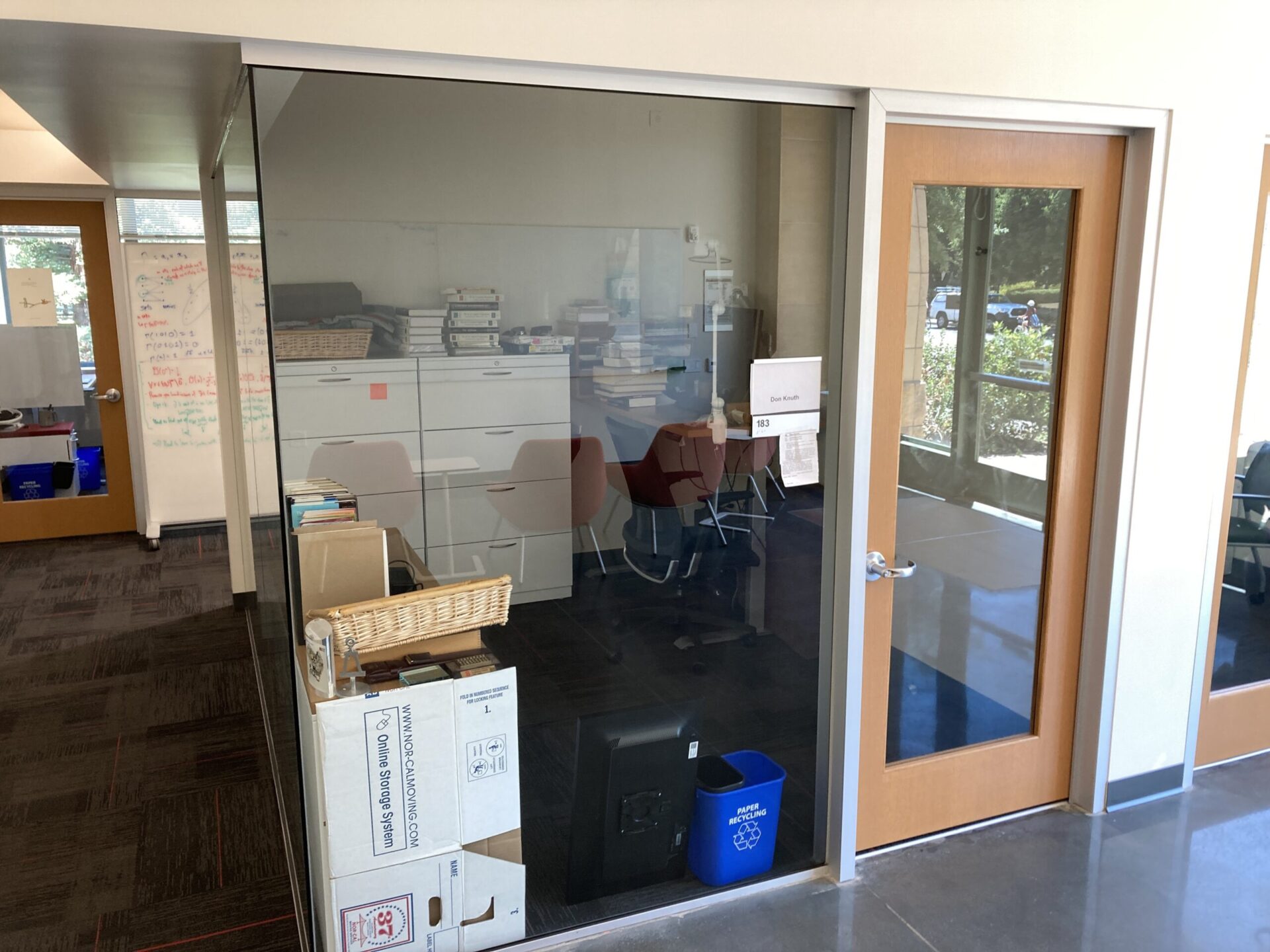
Anecdote: In 2022, while visiting San Francisco, I had the chance to explore the campus. Wandering through the quiet, empty halls of the summer buildings, I was just about to leave when I unexpectedly came across Knuth's office [1]. I had to do a double take—it was surprisingly small for someone of his stature. Yet, in a way, it felt perfectly fitting, a reflection of his unassuming nature.
It's public knowledge that he's a prof at stanford and publicly available directories can lead you to his office. Not to mention that he's famous enough that this is almost certainly not the first time someone shares a photo like this.
If it was a photo of his home I'd understand but this is essentially public knowledge.


Love this piece!
I will surely blog about it on davidfosterwallace.nl in the coming weeks (it'll be in Dutch though).
reply