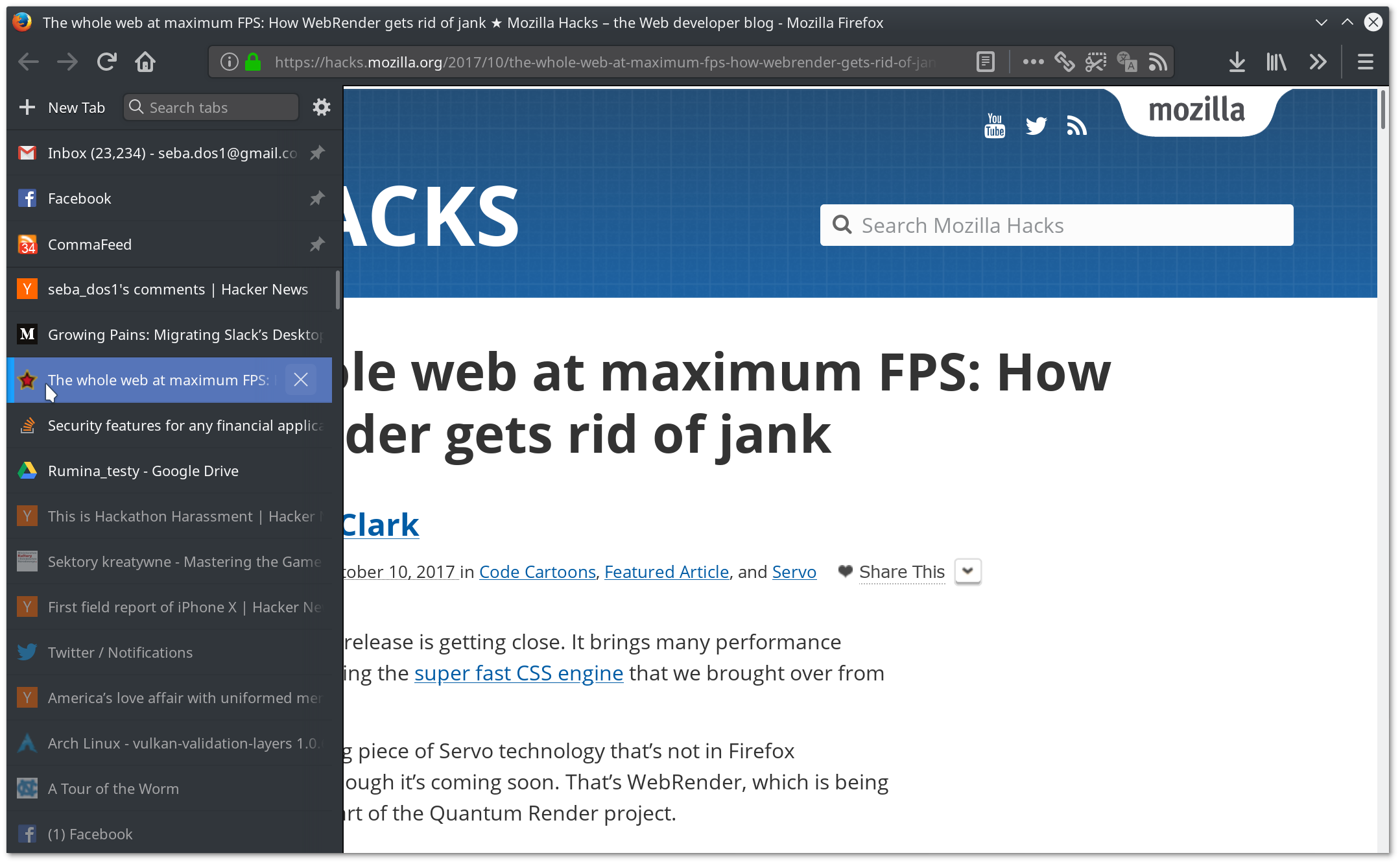
Maybe these are silly things to complain about with fellow techies, but the things that prevent me from switching to Firefox:
The menu bars are enormous even on a compact theme. Bigger than on Chrome. I only have so much vertical space to spare.
When opening a new window, the address bar isn't the first thing to receive focus, unlike on Chrome. With Chrome, I just bang out WINKEY + C + H + R + ENTER + part of query + ENTER and I'm pretty much there
This is a bit misleading. When you maximize Chrome's window the space above the tabs disappears, making Chrome's footprint smaller than that of Firefox.
Though I still wonder why Chrome's menu bar enlarges when the window is not maximized.
I wondered the same thing a while ago and I would think this is to ease dragging the window with the mouse, which you may want to do easily when the window is not maximized.
I'd really like Firefox on Linux to hide the window title bar (at least when maximized) and put the close / maximize / reduce buttons in the tab bar (or make it an option). The tab bar does already allow one to move the window, at least on KDE. Then, Firefox could adopt the same kind of behavior as Chrome for this.
There is a Firefox legacy extension that does just this. Hide Caption Bar Plus. It might not work with this new Firefox as he APIs to control the UI are not exposed as they once were. I use it all the time on my laptops
Last mont Fedora had a release in which you could use CSD to merge the title and the tab bars. You only had to set a variable(maybe widget.allow-client-side-decoration?) in about:config to true. They took that option away because some bugs but it may arrive for the next firefox release.
Thanks for the tip. I didn't know maximus. Actually, kwin does allow writing rules that do exactly that. However, this removes window management buttons, which I don't use often but do like to have. Extensions did that but are not compatible anymore ans never really had an integrated look. I recognize this is mostly feelings though
> When you maximize Chrome's window the space above the tabs disappears, making Chrome's footprint smaller than that of Firefox.
Firefox does the same thing. You can also choose whether you want "drag space" or not on non-maximized windows, or even an old-fashioned title bar. It's all in the customize option (where you can also switch to the compact theme).
FF takes up less UI space than Chrome, when the compact theme is used.
Maximized browsers on wide screen monitors aren't very usable though, you end up with loads of pointless whitespace. The browser works best with a roughly square viewport on 1080p, or tending towards portrait on 1440p.
Oh, absolutely. It seemed that I would have to say goodbye to Tab Center with 57 and was very unhappy with it, but thankfully it turned out that I was able to make it even better than before. userChrome.css rocks :)
I've been running the side-bar version of tab center with this userChrome.css fix but the best I can say about it is that it's "alright". The window close/max/min buttons are just not positioned very well on macOS.
Also, if you hide the sidebar header I think you run the risk of accidentally opening the bookmarks sidebar and being unable to get back to your tabs.
It's probably a subjective proportion thing. Pure metrics aren't necessary what people "measure", maybe the border above tabs is not seen as wasted space. Same for perf, Firefox might be faster in tests, but chrome has an overall feel of speed is "better".
Certainly not the case as far as opening new tabs goes on my machine, an 1.9Ghz with 4Gb RAM. Firefox opens the new tab instantly while Chrome has a noticeable delay. The same with closing tabs, especially heavy ones. Also Chrome takes just a little bit longer to start than the latest Firefox, although I didn't actually measure this.
I think the general perception that Chrome is fast is more a group-think at this point, fostered by a few years of sub-par Firefox performance combined with aggressive Google marketing. There's no real difference since the last few versions of Firefox vs. Chrome.
Trust me, I use "old" core 2 machines, right now on a 1st gen i5 and I regularly cringe at firefox, whenever I run chrome, something lifts off my mind.
I don't charge firefox, it was resetted non long ago, ublock origin and containers (I removed youtube extensions and the likes). Still twitter hungs enough for me to feel annoyed.
I'm not a speed addict, I even love slowness when done right [1], but I rate firefox nightly a little below chrome (stable or canary) at that point.
[1] I use an HP48 calculator, the thing was slower in terms of UI than all its competition but it was such a nice ux design you rarely care about it.
Did you try firefox quantum? I am also using an "old" machine, first gen i7 mobile processor. Firefox (pre-quantum) was slow for me on windows so I switched to Chrome. But firefox quantum was equally fast if not faster.
Now, I am using firefox 56 on OpenBSD, and it is really really smooth.
That was my understanding too. And as other reported that maybe it was use case dependant, loading imgur front page is harsh, no need for video, webgl or anything too fancy. And of course it's much less the case if at all under chrome.
I wish I had tools and knowledge to analyse the perf/stack locally, really.
I manage a world where you can read the title of your tab as you open more. Long gone is the world your curiosity is punished! And the in the tree case, you can track where your tabs came from!
But I also need the horizontal space! I very often tile windows side by side to allow developing while seeing the results, or while reading documentation.
Maybe I'm just picky. I don't know. Chrome does the job pretty well though, even with the bookmarks bar turned on.
A vertical tabs bar would make it impossible to use many sites, like GitHub.
Looks like in Firefox v56 you need to change the start page to "blank" in the preferences (edit: to get the address bar focused after opening a window).
However in current Nightly (which is on v58) the input focus goes straight to the address bar, even in the default settings, so looks like more users complained ;)
I'm just using Ctrl-L to focus the address bar, works on all operating systems and browsers.
Are you running Linux by any chance? For some reason, huge paddings are now very popular in GTK applications with... the result you mention. All GTK3 applications seem to have huge widgets for me, even with compact themes. Frankly, I stopped trying to solve this.
> When opening a new window, the address bar isn't the first thing to receive focus, unlike on Chrome.
Do you have a non-default home page? I can reproduce the problem with Firefox 58 on Windows 10 in my regular user profile but not a brand new profile. My regular user profile had a non-default home page URL.
I'm not sure what the focus behavior should be in that case. If you set your home page to a website, would you still want the address bar to have focus?
"Compact" is the built-in compact styling. Right-click (or otherwise context-click) on the toolbar, select "Customize.." and near the bottom there is a "Density" selector that you can set to "Compact". Note that this is somewhat independent of the color scheme used.
I'm pretty sure that the "Compact" layout is available in beta 57 as well, not just developer edition. It's not in release 56, though; it was added for 57.
> When opening a new window, the address bar isn't the first thing to receive focus, unlike on Chrome. With Chrome, I just bang out WINKEY + C + H + R + ENTER + part of query + ENTER and I'm pretty much there
I guess it's just Linux then. Ah well, I hope you enjoy it anyway. I'm still going to donate to Mozilla at the end of the year. If nothing else, competition is great and their documentation is amazing.
Now if only people would stop using `@here` for every little thing, it'd be easier to separate "blue" notifications from "red" and Slack would actually be the perfect model of async communication. I could prioritize whether to pull myself from my current task to look or not.
Doesn't work when people just write "@here, making nachoes" all day.
`@here` should really be yellow. Only direct communications red. Or something other than the current system.
This new flavor of conservatism is so strange in light of how bound to free market ideals most flavors of conservatism are.
In general, I really quite dislike Conservative/Liberal labels as political stances are not two-dimensional, but rather multidimensional. Parties are loose alliances of disparate groups. And somehow there's this rising contingent of neocons, who also happen to dislike SpaceX.
Does anyone understand this?
Edit: I want to clarify that the alternative to private enterprise competing for government contracts (usually military, again usually a conservative delight) is direct government sponsorship, i.e. NASA.
SpaceX is one of those cases where the free market actually has been more effective. So why not seize on it?
"Neocons" were the foreign-policy hawks of the 2000s. These guys largely call themselves the "alt-right".
They're basically as bad as you've heard, but hiding it sometimes.
Even I find this particular turn against SpaceX somewhat weird. My internal model of the alt-right has largely been that they have one wing who are basically Nazi fanfiction, another who idolize the "throne and altar conservatism" of pre-Revolutionary France, and another who think they should build Warhammer 40K's Imperium of Man as a real-life society (they're very pop-culture influenced). Turning against a private space company seems to indicate that some factions (Nazis plus... someone else?) are throwing the "far-right futurism" faction overboard.
(Again, these guys are really weird, but hey, it's all there on their blogs.)
My big question is: where's Peter Thiel in all this? Just last year, he was the one trying to assure everyone that, oh don't worry, this was all about tearing down overbearing regulations and political correctness in favor of unbound innovation, that the Right weren't anti-science religious people anymore, etc. Turning against SpaceX isn't just throwing a faction of bloggers overboard, it's thrown Thiel overboard, and he was a major billionaire backer for all of this.
Conservative politics is much like French Revolution - built on successive purges of insufficiently ideologically committed members. The NeoCon / Old Bull wing of the Party was largely broken by the Tea Party’s rise and the deposition of longtime statesmen in the ‘10 elections, and has been increasingly replaced by ethnic and religious nationalist purity tests - the 2000’s era Republican Party competed for Spanish and Muslim votes, but those days have long since passed. Crucially, these populous factions are opposed to science, government, media, and academia.
Looking through this lens, Peter Thiel found the same fate as Elon Musk, Gary Cohn, Reince Priebus, and innumerable smaller republican operatives - all thought they would ride the wave and found themselves labeled as just another RINO for being insufficiently ideologically committed.
Thiel was never a major backer of this ethnonationalism, he was just someone who recognized it early and hoped to play that advantage. The Mercer’s, Koch’s and Bannon are the drivers, and everyone else is expendable.
I'm not saying I agree with them, but a common theme I hear from the alt-right is "no gods no masters" (Game of Thrones reference, ding on the pop-culture). Now, nevermind that these guys are setting up as many gatekeeping functions as they tear down; they simply justify it as "protecting real hard-working Americans" through xenophobia.
It's all built on the false nationalism of a flagging superpower, and if any of these people traveled in the least they would see that other countries are actually doing a lot of things better than we do here. We got arrogant, our politicians got greedy, and our voter base got complacent. It's only going to get worse too.
I actually highly doubt that. Most of the "research" done by these people, or those that they rely on, are papers published by think tanks and institutions funded with money from conservative billionaires (e.g. Koch brothers). They essentially live in a different system, one where the person who commits to certain principles most feverishly is considered better. This is not unlike what we have seen in other ultra-religious groups throughout history (e.g. Spanish Inquisition: "You're not Christian enough, so we're gonna kill you").
There was an op-ed published by Krugman yesterday which argued that tax cuts wouldn't really benefit the wealthy all that much since they have already so much, but cutting benefits really impact society's most vulnerable. But Republicans continue to push for tax cuts. Why? Because they live in that alternate universe.
> "no gods no masters" (Game of Thrones reference, ding on the pop-culture)
that's not a game of thrones reference as far as I can tell. It's an old anarchist and socialist slogan. It'd be an odd fit for that part of the right. "No gods or kings, only man" is a Bioshock reference that pops up sometimes in those parts.
It has been many years since I read the books, but I'm pretty sure university intellectuals were actual villains in Atlas Shrugged. IIRC didn't they say that more testing was needed before they could count the new supermetal as safe?
I remember thinking at the time that the hero was being really reckless and that advanced composites often fail in new and unexpected ways and that building an entire rail line out of the stuff before you understand how it fails is beyond risky. Of course because it was a book the metal is perfect in every way and never has a problem, but the real world is rarely so forgiving.
I don't want to go too far off topic, but every time I turn on the news lately I feel like I'm stuck in a dystopian cyberpunk thriller. Funny how we never got the flying cars and jetpacks from our 20th century utopian sci-fi, but the Phillip K Dicks and William Gibsons seem to be right on the money.
My personal theory for a while has been that the world actually did end in 2000. We are living in a parody alternate dimension where the previous gods have been replaced by low-rent hacks. This timeline is like a show that's been renewed for one season too many.
I like to think of Thiel as someone who has access to Facebook, rather than a person. Besides - It's not clear how much of a person is left in the face of such a pool of legitimate signals.
The tendency of the signals to reach a resonant frequency is another matter...
Basically, follow Thiel, he wasn't wrong throwing down with Trump ... another way of saying it ... I don't think it was because of what he believes in.
>"Neocons" were the foreign-policy hawks of the 2000s. These guys largely call themselves the "alt-right".
Hardly. Most nationalists (probably the LCD of dissident right movements) hate foreign entangelements. Trump saying Iraq was a waste of money is hardly an affirmation of the neocon platform of invasion.
And it's an over-simplification to identify the 'anti corporate welfare' view with 'anti-spaceX'. They're anti-spaceX to the extent that spaceX is dependent on the government. I can't imagine these people are any more thrilled by Lockheed Martin or Boeing.
>"Neocons" were the foreign-policy hawks of the 2000s. These guys largely call themselves the "alt-right".
I believe the original poster was trying to distinguish between the two groups, not state that they used to call themselves neocons but now call themselves the alt-right. Though both claim to be conservative each of them take political stances that are anathema to the other.
I've just finished reading "The Shadow World: Inside the Global Arms Trade", which is a pretty bleak and depressing book - I would guess the US Military-Industrial-Congressional Complex (who the Neocons are basically cheerleaders for) would hate SpaceX as they are trying to undercut existing players and reduce the amount of pork - which is basically what makes the MICC run.
At least it's not like Russia where they have almost all of mainstream government and media in favor of funding weapons operations for foreign human-rights abusing tyrants. It's not even always for foreign policy, but sometimes they even say on their national TV that killing more people is necessary because if they stop, defense jobs will be lost.
Except that's us, right here in the US. It does not matter who wins office in that sense, both parties and mainstream media cheerlead the MIC, Wall St, etc, at the expense of human dignity: https://theintercept.com/2016/09/09/wolf-blitzer-is-worried-...
> These guys largely call themselves the "alt-right".
No they don't. Most of "these guys", meaning the new right, distance themselves from that term because of its association with white nationalism.
> They're basically as bad as you've heard, but hiding it sometimes.
No, they're just lumped together in popular media. Breitbart and the Daily Stormer are portrayed as part of the same package, so that distasteful ideas from one can be used to discredit the other. This erasure of the middle ground between center-left and extreme right is referred to in conservative circles as the "unthinging" of the right. It's a smear campaign.
Your statement is a perfect example. In your eyes, anyone on the right not engaging in Nazi fantasies is really just "hiding it". You're "unthinging" the views of the vast majority of them to pretend that they are uniform in ideology.
What do you make of the leaks of Breitbart emails Buzzfeed published? That pretty explicitly shows Bannon encouraging Milo to engage with white supremacists but dress them up a bit and hide it.
Also interesting was the NYT Magazine piece that reported on the Harvard analysis of the network of links of the media. They talk about your issue head-on. Its conclusion was that Breitbart was not itself an extremist site a la Daily Stormer but that extremist sites link to Breitbart for legitimization. Breitbart had a section called "Black Crime" and it contained story after story after story of true(ish) content that Daily Stormer folks would link to say "Look what the n-words are up to now".
Its worth reading the quote:
The last thing Yochai Benkler noted before I left his office at Harvard was that his team had performed a textual analysis of all the stories in their database, and they found a surprising result. ‘‘One thing that came out very clearly from our study is that Breitbart is not talking about these issues in the same way you would find on the extreme right,’’ he said. ‘‘They don’t use the same language you find on sites like VDARE and The Daily Stormer’’ — two sites connected to the white-nationalist alt-right movement. He paused for a moment, then added: ‘‘Breitbart is not the alt-right.’’ Yet precisely because articles on the site were often less extreme than their own worst headlines, Breitbart functioned as a legitimizing tether for the most abhorrent currents of the right wing. Benkler referred to this as a ‘‘bridge’’ phenomenon, in which extremist websites linked to Breitbart for validation and those same fanatics could then gather in Breitbart’s comment section to hurl invectives.
>No, they're just lumped together in popular media. Breitbart and the Daily Stormer are portrayed as part of the same package, so that distasteful ideas from one can be used to discredit the other.
No, Steve Bannon said in an interview that he led Breitbart in giving a spearhead to the alt-right in large media.
>This erasure of the middle ground between center-left and extreme right is referred to in conservative circles as the "unthinging" of the right.
There are really three problems here.
* The "center" and "center-left" are already, by historic standards, quite right-wing on economic policy. This really skews the claim that we're talking about a spectrum between a "center-left" and a "right", insofar as we're really just talking about different degrees of permissiveness or authoritarianism on social issues, plus the "center-left" maintaining the barest rudiments of a vestigial welfare-state.
* Within the Right, the factions that we could have called "center-right" got tossed out as RINOs long ago. Ronald Reagan advocated employee ownership of firms as the way of the future; today Republicans would treat that as socialist heresy. Bush's "compassionate conservatism" is now unheard-of, as are Republican appeals to conservative people of color or immigrants. Paul Ryan and Mitch McConnell really are far-right, in the sense that Ayn Rand is far to the libertarian right.
* The alt-right has deliberately worked to blur the boundaries between the libertarian right and the authoritarian-nationalist right, usually by invoking anti-democratic, nationalistic libertarian thinkers such as Hans-Hermann Hoppe. You know, the guy who wrote that, "in a covenant founded for the purpose of protecting family and kin, there can be no tolerance toward those habitually promoting lifestyles incompatible with this goal. … [violators] will have to be physically removed from society."[1]
When your party has come to have a political spectrum stretching from Ayn Rand on its left to Augusto Pinochet on its right, yes, you are "these guys". Stop now, turn around, purge the alt-right, purge the Tea Party, and reestablish some common-sense and humanity, or else history will remember you as the bumbling enablers of American fascism.
Life, liberty, and the pursuit of happiness, or "physical removal" by death squads: which side are you on?
As a ex Ron Paul supporter with a distaste for the GOP and Neo-Cons, I proudly called myself alt-right.
I joined a few alt-right forums and found similar-minded people. Libertarians, conservatives, nationalists (in the positive sense). Generally smart people. Not Nazis. Not white supremacists.
The term alt-right never seemed to me anything other than right-wing but not Republican.
Then I saw a few New York Times and CNN articles using it differently. Mixed freely with Nazis.
And I heard that white surpremecists were using it to make their views look more mainstream.
Then people started calling me a Nazi.
It’s a beautiful strategy to see a word redefined right in front of your eyes for political gain, but sad too.
If Bannon said Breitbart supported the alt-right, I’ll assume he’s referring to the definition I first understood from the article on his site, and not the one co-opted by the left-sided media and far-right groups.
Please do correct me if I'm wrong, but if you're in favor of Trump's presidency (which seems likely if you support(?) Bannon), how would you counter the dominant view that he's terrible in all sorts of ways, including racism and misogyny.
Is it that he's nowhere near as racist/misogynist as he's made out to be by left-side media? Is it that he's, in hindsight, a bad bet (which I sometimes feel is what Bannon might conclude)?
If you're not in favor of Trump's presidency, but supportive of Bannon, could you elaborate on how Trump failed?
And, finally, if you're not "pro-Bannon" but nonetheless alt-right by your definition, could you elaborate on the nuance between how the alt-right is presented in (quite possibly left-wing) media, and the alt-right that you are proud of?
If you're not comfortable doing this here, I'd love to discuss it over email or something like that. I truly am asking out of interest.
I do support Trump, despite disagreeing with some policies.
I’ll never forget when Ron Paul was called a racist by the media in 2012, and how he was screwed by the Republicans. It still makes me angry today. I don't trust our government, media, or major parties, and all are bad stewards of our Republic. From that perspective, Trump is doing great. This chaos is good in the same way that a controlled fire from time to time is healthy for a forest ecosystem.
I don’t believe he’s a racist or a mysogynist though and I feel pretty confident I could argue against every example people give. However, the only thing it would convince them of is that I am making excuses for a terrible person. It’s not worth it. I’ll just say I think he’s a generally good person operating in a tough environment, and came to that conclusion by going directly to source material.
As for Bannon, I generally like him but I'm happy he's back running Breitbart instead of in the White House. Too controversal. He gave a good interview on 60 minutes last week that I mostly agreed with. And Breitbart - it can be inflammatory, but I find it a good counterbalance to everything else.
Um, that article was written by none other than Milo Y, does that make alarm bells go off? Richard Spencer, noted white supremacist, originated the term years before that article was written. Its inconceivable Bannon was unaware of this when he made that statement.
But bickering over what the word mean or what Bannon meant is not really the point. Give the Buzzfeed Breitbart leak story a read. In it you'll see Bannon encourage Milo to engage with white supremacists but try to dress them up publicly. They are in fact trying to hide it.
> Um, that article was written by none other than Milo Y, does that make alarm bells go off?
I’ve always liked Milo. But even if you don't, the article is still important if you want to understand the history of "alt-right" as it was understood by many people.
> Richard Spencer, noted white supremacist, originated the term years before that article was written
Maybe, but Breitbart brought it into the mainstream for me and many others. I also doubt 99% of Americans knew Richard Spencer’s name until last year.
> Its inconceivable Bannon was unaware of this when he made that statement.
Bannon made that statement a few months after Milo’s article. "Alt-right" didn't have those connotations at the time. I read now that Bannon rejects the "alt-right", presumably because its meaning has changed.
> Give the Buzzfeed Breitbart leak story a read. In it you'll see Bannon encourage Milo to engage with white supremacists but try to dress them up publicly.
It just sounds like journalism. Milo reached out to Devin Saucier (the white supremacist) while researching the article I linked that summarized all the parts of the alt-right movement. Vice did the same thing. Or did you mean something else?
Sure. Limited government, non-interventionism, merit-based immigration, human rights, freedom of speech, freedom to bear arms, protecting the environment, private healthcare, net neutrality, free trade, strong civil society, education left to states, anti-PC, anti-bailouts.
> No, Steve Bannon said in an interview that he led Breitbart in giving a spearhead to the alt-right in large media.
This both true and irrelevant to my point. Quick history lesson of the term:
It was originally coined by white nationalists. Later, when the new right came about, they billed themselves as an alternative to the neocons. Some of them began referring to themselves as alt-right in that sense, as did some outsiders. When made clear that the term originally referred to white nationalism, most of the new "alt-right" distanced themselves from the term, because they were not white nationalists. Some do still use the term in the sense of "alternative to the mainstream right". But, as said before, the vast majority have distanced themselves from it.
Bannon himself denounced the ethno-nationalists using the term "alt-right" multiple times. Furthermore, Bannon and Breitbart are not the new right. Many of us don't read or particularly like Breitbard. What one media outlet decides to call itself has nothing to do with a movement as a whole. Nobody that I know personally, as an active member of the new right, refers to themself as alt-right.
> There are really three problems here.
I'll address those one by one:
> The "center" and "center-left" are already, by historic standards, quite right-wing on economic policy. This really skews the claim that we're talking about a spectrum between a "center-left" and a "right", insofar as we're really just talking about different degrees of permissiveness or authoritarianism on social issues, plus the "center-left" maintaining the barest rudiments of a vestigial welfare-state.
You're muddying the waters here. Given that ardent National Socialists, while economically liberal, are considered far-right, we're obviously not talking about economics. Given that authoritarian communist regimes are considered far-left, we're obviously not talking about authoritarianism and libertarianism.
The new right is, for the most part, ardently anti-authoritarian.
And, in the sense of social conservatism, the current center is extreme left historically.
> * Within the Right, the factions that we could have called "center-right" got tossed out as RINOs long ago. Ronald Reagan advocated employee ownership of firms as the way of the future; today Republicans would treat that as socialist heresy.
Many, sure. And yet there are many of us who are being lumped into the "alt-right" for our social views, myself included, who would not react that way.
> Bush's "compassionate conservatism" is now unheard-of, as are Republican appeals to conservative people of color or immigrants.
Simply false. We have no issue with people of color or immigrants. We simply disagree with poisonous Cultural Marxist policies on such issues becoming law.
> * The alt-right has deliberately worked to blur the boundaries between the libertarian right and the authoritarian-nationalist right, usually by invoking anti-democratic, nationalistic libertarian thinkers such as Hans-Hermann Hoppe. You know, the guy who wrote that, "in a covenant founded for the purpose of protecting family and kin, there can be no tolerance toward those habitually promoting lifestyles incompatible with this goal. … [violators] will have to be physically removed from society."[1]
This is not a view shared by most of the new right, only certain more authoritariam elements. It certainly isn't any more extreme than the leftist craze for punching "Nazis".
> When your party has come to have a political spectrum stretching from Ayn Rand on its left to Augusto Pinochet on its right, yes, you are "these guys". Stop now, turn around, purge the alt-right, purge the Tea Party, and reestablish some common-sense and humanity, or else history will remember you as the bumbling enablers of American fascism.
> Life, liberty, and the pursuit of happiness, or "physical removal" by death squads: which side are you on?
>Simply false. We have no issue with people of color or immigrants. We simply disagree with poisonous Cultural Marxist policies on such issues becoming law.
>This is not a view shared by most of the new right, only certain more authoritariam elements. It certainly isn't any more extreme than the leftist craze for punching "Nazis".
As a matter of fact, mass purges are more extreme than individual crimes.
As your page admits, it has another, original meaning. One which is conveniently downplayed. This is another example of "unthinging". Don't complain about the rampant Cultural Marxism, or you're just a dirty antisemite!
> As a matter of fact, mass purges are more extreme than individual crimes.
One large segment of the population singling out another for physical harm based on political ideology is a mass purge.
For anyone interested, "Cultural Marxism" refers to the application of Marxist critical theory to the social sciences, particularly issues of race, gender, culture, and identity.
Current mainstream leftist memes, with a focus on issues like "white privilege", and the systematic inversion of this supposed privilege, cannot be described as anything but Cultural Marxism.
If you want to get conspiratorial about it, SpaceX is a huge threat to both the Russian space launch industry and to Boeing/Lockheed.
More seriously, in the 2017 conservative pathology, the Russian government are 'good guys' and American businessmen who quit Trump's economic council are 'bad guys'.
With regard to Peter Thiel, I am not sure being thrown overboard is the right metaphor. He has chosen to ride the tiger, and may have trouble getting off, if he wants to.
I imagine it's because Elon Musk leans liberal (or at least non-Republican), and in particular is a highly visible crusader for action to combat climate change. The American right wing has decided that denying climate change is a core value, and trying to get people to take action against it is a mortal sin. SpaceX is not directly involved in that, but Tesla is, and I doubt places like Breitbart are interested in carefully drawing lines between the man's different companies.
>SpaceX is not directly involved in that, but Tesla is, and I doubt places like Breitbart are interested in carefully drawing lines between the man's different companies.
So you are accusing Breitbart of attacking Tesla (even though this is about SpaceX) because they won't "carefully draw lines", without a hint of irony that you can't be bothered to draw careful lines between the companies, and have dragged Tesla into the conversation?
Not every criticism about SpaceX or Tesla is about disliking Musk. If only it were that simple.
I spend most of my time online in what the HN crowd would describe as "right-wing circles", and I have to agree with this. I'm seeing a rising sentiment that Elon Musk is someone who is skilled at over-promising and under-delivering, while repeatedly using subsidy and direct government funding to fatten his own pockets.
I have no idea what this notion is based upon; it's not really something that has interested me.
There's a kernel of truth to it: he does over-promise, and often deliver short of his promises. It's just that the result is still pretty spectacular. It's not like he promises the moon and then hands you a bag of crap.
Honestly I think part of it might be that Musk, in a way, represents an (almost) naive hope ("let's go to mars!"), and as far as I can tell the alt-right mostly runs on cynicism and criticism.
I find it hard to properly argue this, because it's based on mostly a feeling I get from following /r/the_donald and various other alt-right(-ish) sources.
But the best way I can explain it is how I feel when I watch Fight Club, in particular the scene where Jared Leto gets beaten to a bloody pulp, and the main character says that he just 'wanted to destroy something beautiful'. I remember that the first time I watched the movie as an angsty teenager, this scene gave me a (thankfully) fleeting feeling of power, anger, mixed with disgust and self-loathing.
Interestingly enough, a game like Bioshock had a similar effect. The message is clearly that the 'Randian' approach leads to all sorts of horror, but for some reason there's also something appealing about the situation, at least to the person that I am (and I can easily see a version of myself in a parallel universe being part of the alt-right).
Anyways, my point is that anything that has a whiff of naiveté, grand hopes, and the kind of 'moonshot' idea that could possibly lead to utter failure, all of that is antithetical to the general alt-right perspective.
At the risk of shoe-horning an author I like into this, I nonetheless feel that David Foster Wallace somehow is able to capture some of this.
> “So far it seems as if people think it really is sort of a book about drug addiction and recovery and, you know, intentional fallacies notwithstanding, what was really going on in my head was something more general like what you were talking about before, that there is a kind — that some of the sadness that it seems to me kind of infuses the culture right now has to do with this loss of purpose or organizing principles, something you’re willing to give yourself away to, basically. And that the addictive impulse, which is very much kind of in the cultural air right now, is interesting and powerful only because it’s a kind of obvious distortion of kind of a religious impulse or an impulse to be part of something bigger. And, you know, the stuff at the academy is kind of weird because, yeah, it’s very high-tech and it’s very “become technically better so you can achieve x, y, and z,” but also the guy who essentially runs the academy now is a fascist, and, whether it comes out or not, he’s really the only one there who to me is saying anything that’s even remotely non-horrifying, except it is horrifying because he’s a fascist. And part of the whole — part of the stuff that was rattling around in my head when I was doing this is that it seems to me that one of the scary things about sort of the nihilism of contemporary culture is that we’re really setting ourselves up for fascism. Because as we empty more and more kind of values, motivating principles, spiritual principles, almost, out of the culture, we’re creating a hunger that eventually is going to drive us to the sort of state where we may accept fascism just because — you know, the nice thing about fascists is they’ll tell you what to think, they’ll tell you what to do–they’ll tell you what’s important.”
My apologies if this doesn't really add up to anything. The topic just hits a nerve and I'm trying to find a way to properly put it into words.
The human contribution and the potential consequences are considered still unproven hyperbole. The cost/benefit of doing something else is an ongoing discussion.
Climate change is denied. Human causation is denied. The damaging consequences are denied. The net benefit of mitigation is denied. All of these positions can be found from mainstream right wingers in the US.
High quality links that cast credible doubt on the cause of rising co2 ppm and its long term effects? I'll bet money you have none.
Items that have been debunked many times are obviously not high quality or credible.
P.S. I wouldn't normally be so harsh... It's just a bit crazy how many times these claims keep coming up, when the evidence and the science is so crystal clear.
This theory should be easy to prove or disprove. Just look for other corporations that make money from government contracts or benefit from government policies and see if Breitbart is consistently going after all of them.
As you recognize the simplistic nature of labels, you should not be surprised when a group goes against type.
I think the key to understanding the so-called neo-consrvatism is that it is not 'for' anything; rather, it is against a long list of things, and virulently so. They are conservative in that conservatives have generally defined themselves by opposition to whatever has been changing in the societies of their generation.
Its other feature is the belief that its ends justifies the means, including the incitement of irrational anger and even hatred, which they regard as a virtue. This trait is latent at all political extremes, but only gains traction when a significant number of the generally more moderate or uninterested members of the populace believe they are being cheated out of something they are entitled to.
I think we are seeing combination of short-sighted self-interest and "the enemy of my enemy is my friend", together with a willingness to use irrational arguments to advance those interests.
There have been many historical precedents, but perhaps none more so than the French revolution, which went through several cycles of this. The Terror only ended when the surviving politicians all realized that they were more likely to be executed than hold on to executive power, if they carried on this way.
My money is on chaos. You take all these powerful and/or power-hungry people, who all want their way, but they are also influenced by other movers and shakers to want certain outcomes, and soon it's one giant spaghetti strange attractor.
The only consistency with Breitbart seems to be that they never let any of those annoying facts get in the way of the narrative. I can't see any ideological justification here, SpaceX getting money from the US government isn't fundamentally different than ULA getting money from the US government.
The article does imply at the end that there is likely someone behind these articles that has a specific interest in this narrative.
It actually is different. ULA gets $880 million to $1 billion per year just to keep the factory lights on[1] for the EELV Launch Capability Contract. This isn't money for a service such as launches or new rockets, it is just to keep the lights on. SpaceX doesn't get any of that. If anyone is subsidized by the USG, it is overwhelmingly ULA. SpaceX could have simply charged 1/2 of ULA's $422 million per launch and instead chose to go way below that. This is an example of private enterprise overwhelmingly helping the tax payers through healthy competition. ULA was allowed to essentially rip off the tax payers at $422 million per launch whereas SpaceX is charging < $100 million per launch depending on mission objectives and integration requirements.
Lets not be too harsh on the ULA. They offer services like vertical integration that only the government cares about and they've gone over 100 launches without a payload loss. So if I was sending up a $10 billion space telescope they're the obvious choice for that.
I doubt they're going to get any more business for $200 commsats though now that SpaceX is getting on tempo.
The reliability standard they've set is indeed impressive, but they're simply milking the fat cow (USG) for cash. They were a perfect Rockefeller style monopoly with an utter lock on the military launch market until SpaceX sued the USAF to make it a normal bidding process.
Shaking that up a bit is a very good thing for overall use of tax dollars. I'll relent and agree entirely with you that there is a place for their extreme reliability. Then again, SpaceX is going to get there and they want to do 1 launch per week (40-50 launches total in 2018). If they don't develop the Vulcan engine and some sort of story for reliability, they're going to go the way of the dinosaurs. SpaceX is fighting for better (and cheaper) access to Space for everyone whereas ULA will soon be fighting to exist if they don't make serious changes soon.
And they get more bang for their buck saving taxpayer dollars. The alternative is dependency on Chinese or Russian technology which also seems to be against their isolationiat views. It makes no sense to me. It just seems like they don’t like anyone who is liberal.
I'll be honest, based on the comment section, these articles are not working very well. There's some who agree, but an equally vocal section accusing Ron Paul of being a shill for "old school aerospace" ala ULA, or even accusing that these articles are "pro-Russia".
I must say that instinctively, favoring the aerospace "status quo" marketplace over SpaceX certainly doesn't seem like a terribly conservative viewpoint. I'm sure whatever monied interest is pushing these articles (quite likely either old school aerospace, Russia, etc.) kind of wanted to use Musk's "liberal" views on climate, and general anti-government sentiment against "handouts" and "subsidies", to try to justify their attack pieces. But as far as I can tell, a heck of a lot of people are seeing through the ruse this time.
1) McCain and Rogers's policy views are close to those of neocons (aka, cold-war liberals), best known for their hawkish foreign policy and efficient, smart gov't. They both are supporters of SpaceX and are behind the new legislation that supposedly favors SpaceX. That said, neither McCain or Rogers identify themselves as neocons -- they are just very hawkish when it comes to foreign policy.
2) Ron Paul and those critical of SpaceX (in this particular context) are paleo/libertarian conservatives. They are the polar opposite of neocons in that they are fervently against hawkish foreign policy and crony capitalism which they view as inevitable products of a big gov't.
Now, SpaceX is something neocons would love and SpaceX has cuddled with those two politicians to spice things up. SpaceX's political, campaign donation and McCain and Roger's support of SpaceX/the new legislation which seems to favor Space-X is a big no-no in Paul's book.
Very few conservatives in power are bound to this as an abstract principle; most are bound to markets as they benefit specific incumbents. In this case SpaceX is threatening the incumbents Boeing and Lockheed, who are responding with a lobbying campaign, including the generation of favourable press coverage.
Everything these days is polarized on a one-dimensional axis. Musk does electric cars and solar, so he's an environmentalist, thus a leftie, and thus their enemy. He also left some Trump advisory council a while back.
Correct, this is an identity politics and team membership controversy, not rooted in good policy.
A good parallel would be boycotts of Hobby Lobby due to ideological differences with its ownership. The fundamentals of the business are at worst benign. (I am not making a statement in support of the viewpoints espoused by the Hobby Lobby ownership).
SpaceX is a public good since it saves hundreds of millions of tax dollars, so this is unfortunate.
I think that framing this in an ideological way misses most of what is happening in political discourse right now. Ideology plays a role, but it is in the backseat.
Here's my theory:
Social media has created a new environment (in the ecological sense of the word) and we are witnessing people figuring out all the little niches that exist in this new environment which they can profitably occupy. So, in an example like this, what's really happening is that there are a handful of people who stand to gain tremendously by finding a new target for the mob's outrage, because outrage is what drives traffic and traffic is what allows these people to be full-time "social media personalities".
But the thing is that, for these people, the outrage of the mob is what truly motivates them, not ideology. There is a certain personality type that makes it's way in the world by maneuvering to the front of the mob. Being ideologically consistent is an after thought, if it matters at all. All you need is for your target to kinda sorta look enough like your ideological opponents that you can sell it to the mob. That is the litmus test for choosing a target and what I mean when I said, above, that ideology is in the backseat.
This phenomenon is driven by the opportunities that social media presents and certain actors capitalizing on these opportunities. Which means that this phenomenon is not relegated to right. As a great example, a conservative commentator, Ben Shapiro, recently spoke at UC Berkeley. Some of the protest signage was claiming to be against white supremacy, but, as you may have guessed by his name, Ben Shapiro is Jewish. So, you know, not a white supremacist. And he is not even a Trump supporter.
But a reasonable and nuanced take on things is the antidote to outrage, so of course reason and nuance will be absent among the people on the right and the left who benefit from the outrage of the mob.
US has a bit weird definition of conservative (similar to the term liberal), European definition of conservative is not always pro free market nor always pro free trade.
simplified European definitions on space travel:
socialist: all government run ("planned economy")
social liberal/social democrat: political co-operations (unions) partly funded by government, private corporations funded by government and government corporations, all government regulated ("corporativism")
liberal: privately funded, government regulated ("free market")
I don't quite grasp the details of the story, but the "four kinds of money"[1][2] theme may help understand the point of view.
Why exactly would Musk spend money in a way that disturbs conservatives more than how say ULA does it, is probably complicated, but I assume they have their reasons.
PS. Also, quite illuminating is Ron Paul's original opinion piece on foxnews [3].
The whole thing doesn't even make sense. We used to have a monopoly that cost a whole bunch of money. If Elon Musk can do it for less, then he's breaking up the original monopoly.
Have you read Ron Paul's piece? I think the argument about Russia makes a lot of sense. He claims that introducing protectionism in space actually made things more expensive, not cheaper.
"Specifically, Section 1615 of this year’s NDAA expressly forbids the Air Force from developing new launch vehicles by restricting expenditures to the development of new engines or the modification of existing systems. This prohibition is supposedly designed to address the “Russian threat” -- a threat manufactured by those seeking a new Cold War. In addition to flaming anti-Russian hysteria, this provision makes the company SpaceX the only affordable option for launch services. "
Also, shouldn't we be glad that space exploration is an international effort? Why should the USA design and build itself its entire launch systems?
I've done development with all the databases, languages and packages installed on the host machine, as well as with vagrant. With the VM, I have to ssh in, or switch windows to run tests, whereas before I could just run the tests in vim. How do people achieve fluency with these?
I suppose I could install some more of my tools on the VM, but if you take that to its absurd conclusion, I'm just running a clone of my host on the VM.
It seems more useful, maybe, to just run databases and other services in the VM. Those are the more difficult bits to manage usually. A good programming language already has version and package management facilities.
Or perhaps am I missing something? Anyone have another workflow?
Jetbrains IDE has a good SSH & Vagrant support so mostly I create tools/tasks that launch through ssh (or use the built-in ssh client but that's like any console except you can stay in the IDE), same for the database tool.
We don't use Vagrant, but we use VMs. The workflow is a little bit more convoluted than directly on the host, but we get the benefits of having a consistent way to create environments that are closer - if not identical - to what our customers have.
In essence, we do most of our development on Windows, but deploy our solution on Linux. For databases, our former development environment relied on Windows drivers that didn't have the same bugs than the Linux implementations. Hence, we caught these bugs much later in the development phase.
Another advantage is that we can deploy different releases of our solution simultaneously.
Of course, the cost to get there was to define a new pipeline to build artefacts that we ship on the boxes, but that was a little price to pay.
I have never been able to find a performant way to mount host files on a VM, so I just use a headless Ubuntu running in VMware as my dev environment. File mounting in docker containers doesn't have the same speed penalty on a Linux host as it does on win/Mac. I use tmux and vim. I've been using this setup happily for years now.
I've always liked essay writing. I mean, not so much as an assignment, but they're satisfying to bring together; from perfecting the construction of individual sentences, to structuring the flow of paragraphs.
To that end, I quite like writing documentation, especially after finishing a large milestone. It's a good break from just coding, while also being very helpful for the team as a whole.