This isn't for piddly-ass "climate change" of a handful of degrees, this is "the sun is two times brighter than it was a million years ago and we're no longer in the habitable zone".
For our problems shades in Earth orbit would be just fine, and are probably the best solution overall, really, for dealing with climate change. Not just "man-made" climate change, but all climate change, full-stop.
Shades in Earth orbit raise the wonderful prospect of triggering Kessler syndrome. I'd rather not make near Earth orbit uninhabitable any time soon, thankyouverymuch.
By the time we're building one of these, we probably have a solution for Kessler. There's really no shortage of possibilities. Kessler syndrome isn't a fundamental of space travel, it's a momentary accident of our being able to launch things, but not launch things cheaply enough for us to justify launching things just to clean up the orbital space. By the time we're seriously discussing this sort of solution, clearly we can launch things cheaply enough to clean up inner space, or, more likely, simply build the cleaning solutions in space to begin with.
Though I can't help but enjoy the dark humor of refusing to fix one somewhat hypothetical problem with a hypothetical solution because it might create a different hypothetical problem. ("Hypothetical" here simply in the sense that none of these things have actually happened yet.)
My (obviously unmodelled, hypothetical) low-earth-orbiting solution would be to use 'intelligent' rings of what I will call "dancing shadow leaves" (akin to the 'shadow square' system that provided day/night cycles for Ringworld). Vast numbers of relatively small 'leaves' made of graphene-like material would be connected into a large number of rings held together by conductive nanotube-like 'wire'. The leaves would use electrostatic charge to change their angle and to jump to slightly higher or lower orbit (to avoid orbiting debris). Being able to change their angle appropriately for their changing position above the earth they would shade or not shade different areas on the ground. A supercomputer capable of modeling the affects of such shading, would use the system to have some control of over the weather in some areas. Just the ability to cool areas of the oceans that spawn tropical storms might allow the system to pay for itself. And ideally the leaves would also be photovoltaic and beam power to the surface. As long as I am dreaming, the leaves would be transparent to the wavelengths most supportive of photosynthesis so that they provide shade without lowering CO2 uptake.
And before anyone chants "Ringworld is unstable" of course my rings's orbits would be constantly adjusted by using solar radiation pressure, electrodynamic tether thrusting and/or ion propulsion.
To be able to shade most of the planet would require ~100X the surface area of the L1 proposal. But using recent nanomaterials and the much smaller transportation distances for LEO might make up the difference in cost. In addition a much smaller coverage system might still be enough to keep critical areas of glacier and tundra below freezing for more of the year and keep the most critical tropical storm spawning areas of ocean cooler.
Let's see. It seems to me the obvious approach would be a very large number of solar sails manufactured in space. Eric Drexler wrote a thesis about that in the 70s, for transport instead of shading: https://dspace.mit.edu/handle/1721.1/16234
The general idea was to make lightweight thin films by metal vapour deposition onto wax (or something, iirc), followed by heating the wax to remove it. These films can be far thinner than what could survive launch from Earth and unfolding.
I'm not gonna reread it now, but say 50nm thick (which is above the knee of the opacity curve) times the cross-sectional area of the Earth gets you about 6 million cubic meters -- you wouldn't make one giant shade, but a lot of small ones; there's overhead for each one's control/power/cooling. Aluminum masses 2700kg/m^3, so we need to manufacture 17 million tons of solar sails (+ the overhead) somewhere up in space, I guess at a convenient asteroid that supplies the materials? And then navigate them to the Lagrange point, but solar sails are great for that.
Easy for me to say, but this sounds doable in this century if we wanted to enough. If you just want to reduce insolation by a few percent, then scale down the requirements to a few percent.
Added: I found the R. Angel paper the OP referenced, with the sunshade design: http://www.pnas.org/content/103/46/17184.full -- also a thin-film swarm, though not as thin, launched from Earth, and 20 million tons for 1.8% reduction.
Also, my sketch above left out stationkeeping overhead, which I was vaguely thinking could be small: rocking back and forth to alternately spiral out and in from your orbit. But that's wrong, it's not even in orbit. I'm not sure how well you can do.


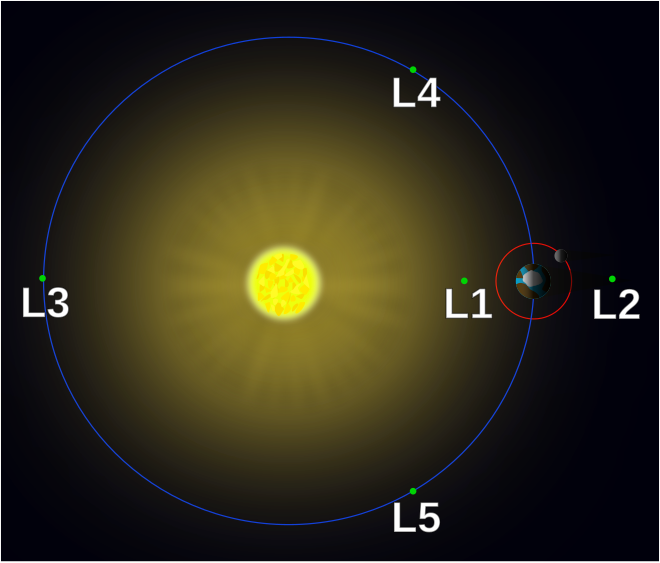
Maybe we should be building ourselves one of these...