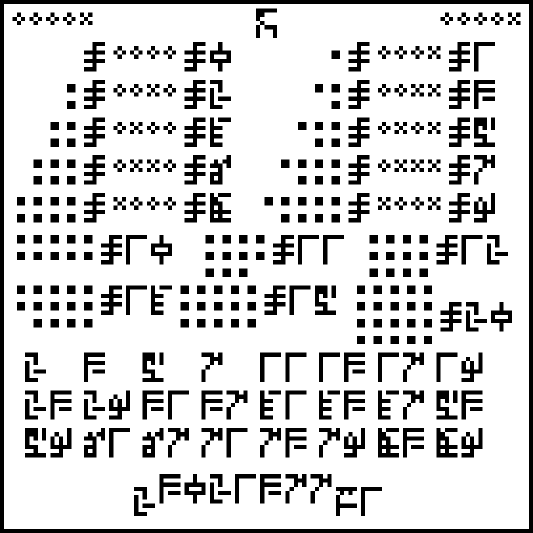
Consider that in every other context listed, {glyph1} {glyph2} (where both glyphs are numerals) indicates "{value of glyph1} * {base} + {value of glyph2}".
For anyone with a passing familiarity with our number system, yes it's straightforward. But this wasn't produced for those people - it was produced for people with absolutely no prior experience with human culture whatsoever.
I wonder why every alien-oriented mathematical thing I've seen includes binary. It doesn't seem very important to me to communicate that we understand base two, versus showing some more advanced mathematical formulas.
Because we've learned from the Rosetta stone that having more than one language system is extremely helpful for translating things. Translating something like this with no knowledge of the human race is an enormous endeavor. By providing three bases (base 1, base 2, and base 10), it'll be much easier to extrapolate their meaning. Base 1 should be fairly universal, and since much of our world today revolves around base 2 and 10, having each of those present will make for an effective starting point.
Think of it this way - if an alien probe landed on earth today, wouldn't it be a nice starting point to know that they use a mix of base 7, base 342, and base 61 for their number systems?
if an alien probe landed on earth today, wouldn't it be a nice starting point to know that they use a mix of base 7, base 342, and base 61 for their number systems?
I doubt that would be useful information. I would be most interested in knowing what number systems they used natively. Humans (almost?) universally use base ten.
The assumption is they will understand counting dots easily, = sign, then base 2, then another = sign, then base 10. It's to help both with the = sign and figuring out we use base 10.