Homicide rates are the key number to track. Other crime statistics have big reporting problems. Police can easily not report a crime (especially when there is pressure to make the stats look good), people stop calling police if they think the police won't do anything, etc. But it is very hard to hide a body.
And homicide rates have risen substantially in the last two years (up 10.4% in 2015, and projected for 13.1% this year). These are the biggest increases in a generation.
I'm not sure if the de-incarceration is responsible for the rise in crime. From my following, it seems like the police backing off in response to protests, riots, and consent decrees has a bigger impact. And I'm not a fan of prison -- there are better ways to deter crime and to keep violent criminals away from normal people. But I do notice that most times when I see a murder in the news, and the suspect has been apprehended, the suspect has a disturbingly long wrap sheet and I've wondered to myself, "how was this person allowed back out into civilized society."
According to 2014 FBI stats related in June, 2014 was a 50 year low for the us homicide rate. Two takeaways: first, FBI data hasn't been released for 2015 yet. Second, as the denominator is getting smaller, small variance leads to bigger year on year percentage shifts.
Ah, correction. FBI data is out for 2015. Murder nationwide has gone from about 13k to about 15k. The point about small denominators stands, especially in light of a 50 year low in 2014. Is this a new murderous America or a reversion toward the mean?
Only you can prevent the grievous misuse of statistics.
You could also easily make the argument that the murder rate is up due to increased weapons sales.
It's all about the policy you want to sell. You're seeking to silence legitimate criticism. I'm seeking to reduce the likelihood someone will do something irrational with a loaded weapon.
If you're interested in facts, there's only one side supported by evidence [0] but hey, don't let that deter your campaign. Keep championing the destruction of black bodies.
The link is about guns and suicide, how is that meaningful as a response to my comment? Suicide is not crime, and I didn't mention guns at all... or anything about black people.
I'm not trying to silence anybody, in fact I'm saying something that mainstream media is unwilling to say. I just pointed out that recent criticism of police is by far the most likely reason crime rates are increasing in big, poor cities.
I'm pointing out that irrational acts of violence - whether homicide or suicide - are made more prevalent and lethal in the presence of cheap, abundant weaponry. As a result of the 37 mass shootings that have occurred during the last administration, gun sales have hit record levels[0], and following from that, homicide rates have increased. I'm connecting the dots in this way, you are connecting the dots in another.
You are making an assertion that there is a negative impact of "recent criticism of police" and that it has directly led to this outbreak of homicide. What criticism, specifically? By which groups, specifically? And what should be done about it, specifically?
Both ways of connecting the dots leads to the same conclusion. Crime has been increasing in large, poor cities.
These people by vast margin are not legal gun owners, so I think it's a bit premature to connect gun sales to rising crime rates.
The biggest thing on the news radar before the increased crime statistics is recent critisicm of police. Even police chiefs and mayors of many of these cities have gone on record saying that the public backlash against police was going to cause officers to be more cautious and patrol problem areas less. And a year later this is exactly what happened.
Nobody can even prove correlation=cause for anything but the evidence in this case is pretty overwhelming.
Chicago specifically, which is pointed out as one of the largest increases, had it's police chief resign and was under state and federal investigation.
What do you think this does for the public perception of the police dept? The police are fearful of causing the next Freddie Gray and the political machine doesn't want their hands anywhere near anything involving the police dept, which would surely affect the ability for them to operate effectively at least at some level
>These people by vast margin are not legal gun owners
Anti-gun control people keep making this argument, and fail to take into account the larger economic impact of more inaccessible guns. If they are restricted it makes them more expensive to obtain on both the legal and illegal markets. Like you said
> large, poor cities
If in fact these cities are as poor as you say - which, speaking as a resident of Chicago, is a grave distortion of our reality - then this only bolsters my argument. Guns shouldn't be affordable or accessible to the average everyday criminal. Controlling the supply allows us to control the price.
> a bit premature to connect gun sales to rising crime rates
This is directly addressed by the evidence I provided. Gun deaths are inexorably connected to gun sales.
>What do you think this does for the public perception of the police dept?
CPD is taking steps to address its image, getting rid of the poor leadership that led to this crisis is exactly what they should be doing. They're hiring people from disempowered communities, organizing outreach, building trust. CPD is busy busting its ass demonstrating its ability to operate effectively in this environment. You need to be aware that police departments originated[0] not as public defense organizations, but as union-busting, organizer-murdering hired security. Things have changed, but as recent events[1] have shown, there is still work to do. As someone with family members in the CPD AND as someone with family members of color, I am keenly aware of the tightrope both sides must walk. There is no perfect solution, but burying your head in the right-wing propaganda machine does none of us any good.
At least I'm proposing a solution. Again, you make an assertion that there is a negative impact of "recent critisicm[sic] of police" and that it has directly led to this outbreak of homicide. What criticism, specifically? By which groups, specifically? And what should be done about it, specifically?
Criticism is causing increasing crime? What kind of Blue Lives Matters bs logic is that. And have there not been repeated case she of glaring misconduct where justice was not served. And the police wanna play victim now? I'm all for increasing police training and even better pay to attract better candidates, but there are many more factors at play than criticism.
It's a direct result of police backing off due to protests.
I'm not going to post the obvious glib response, but it's threadbait to say something like this without support. "Probably" doesn't cut it, so consider this a challenge.
I read somewhere that one way to measure crime is surveys that ask people about crimes that they have been a victim of in the previous year. These surveys indicate that the reduction of crime isn't due to reduction in reporting or policing.
That's how England and Wales does it. The police record crimes, but these are not seen as statistically sound, and so the Office For National Statistics also does a crime survey.
> The CSEW, formerly known as the British Crime Survey (BCS), is a face-to-face survey asking people who are resident in households in England and Wales about their experiences of a range of crimes in the past year. The survey interviews both adults and children. The survey started in 1982 (covering crime experienced in 1981) and is conducted on a continuous basis with around 35,000 adults and 3,000 children aged 10 to 15 years old interviewed each year.
>> And homicide rates have risen substantially in the last two years
Homicides are down in the majority of cities, like NYC, Flint and Detroit. However, they are up in cities like Chicago, Baltimore, and St. Louis which are bucking the national trend of lower homicide rates.
Homicide rates - and some other crimes - are massively distorted by small, high-crime urban areas.
If you pluck out the data a very small number of residents from specific hoods in Detroit, Chicago, DC etc. - the 'rest of America's' homicide rates start to look more sane.
If you pluck Aboriginal crime out of Canadian crime stats, the numbers start to look like those of Northern Europe.
I think this is important because random crimes that happen in 'normal circumstances' may not be a function of the crazy social dysfunction in certain neighbourhoods.
I'm not saying anything political here, I do believe anyone murdering anyone else is 'responsible' for it and can't just blame the fact that their dad was in jail, mom absent, schools sucked etc. - however - those are obviously massively correlating factors in some areas, much more than others.
If I were pres, I would basically have a 'national crime / social reconstruction strategy' focused on those 'bad areas' that comprised of a bunch of things.
Most of America is within the range of 'normal' for homicide - but still considerably more violent than other advanced nations.
> Homicide rates are the key number to track. Other crime statistics have big reporting problems. Police can easily not report a crime (especially when there is pressure to make the stats look good), people stop calling police if they think the police won't do anything, etc. But it is very hard to hide a body.
I agree with you, it is true that the homicide rate is the most fair statistic to use. But even that can be manipulated. For example, it is often hard to distinguish between arson and accidental fires. Some types of murder can appear to be suicides at first glance and vice versa. Another twist is disappearances where the body hasn't been found yet. This is why you'll never find an exact number of murders for a specific year, just an estimate.
So different reporting routines or an overworked police force could definitely impact the number of murders reported each year. For example suppose a junkie falls from a balcony and dies, if the police department have spare resources maybe they'll investigate and find out it's a murder, if they don't maybe they'll be happy to close the case as an accident.
Peter Moskos has written a lot on this. As part of his PhD, he spent two years as an actual cop in Baltimore. Now he is a professor of criminology in New York. IMO, he does a good job writing in a balanced and truthful perspective about crime.
"I don't know what's going on everywhere (or even most-where), but I can tell you a bit about Baltimore. And I suspect it holds true in many cities. I looked calls for service, arrest numbers, and crimes. Most dramatic is the drop of arrests in Western District....Now there are good and not so good reasons for this drop in arrests. But leaving that why: it happened. Police were less involved, by choice and necessity, and violence skyrocketed. Just because correlation does prove causing, correlation certainly doesn't mean causation is impossible or even unlikely. I mean, what else changed in the Western except police and crime?...Cops stopped making discretionary arrests and being proactive in clearing corners and frisking subjects. Look, it's no surprise where shootings happens and who gets shot."
http://www.copinthehood.com/2016/01/the-baltimore-6-effect.h...
I also think that when you have open-air drug dealing, and gangs openly controlling the streets, then that turns senior gang members into role models, and it incentivizes young teenagers to join gangs for protection. Then as part of joining, they get involved in beefs and violence. That is my take from reading various ethnographies.
The reason nothing is being done is because prevailing opinion does not agree with me. The emphasis over the past fifty years has been less discipline in schools. ( http://www.city-journal.org/html/who-killed-school-disciplin... ). There was a police crackdown in the 1990s, but it was more targeted at keeping violent people out of the nice neighborhoods, rather than completely eliminating gang violence in the ghetto neighborhoods. I think that is because the liberals see the police as suspect and problematic, and don't want to empower them, and because the conservatives don't really care about the ghetto as long as it doesn't effect them.
This is a very good comment, and it seems pretty reasonable. I don't think police are the right agents to enforce societal change though. It seems like a lot of criminals, start off rather young charged with crimes like shoplifting etc, and that record haunts them forever, by shutting off a lot of opportunities forever.
I don't know what the solution is, how to prevent so many American youth who would perhaps have been contributing members of society and culture. I found it rather surprising that such kinds of conditions exist in a developed country like the US; its usually something you find in less developed countries.
I don't think police are the right agents to enforce societal change though.
I mostly agree, but I do think the police could do more to crack down on the most brazen instances of gangs being the de facto government of various neighborhoods.
It seems like a lot of criminals, start off rather young charged with crimes like shoplifting etc, and that record haunts them forever, by shutting off a lot of opportunities forever.
That's not my sense from the various ethnographies I have read. Where are you getting that from?
I found it rather surprising that such kinds of conditions exist in a developed country like the US; its usually something you find in less developed countries
There is a racial element to this. When I was traveling in Brazil, the black favellas of Brazil had a lot of similarity to the black ghettos of the U.S., and the white areas of Brazil had a lot of similarity to the white areas of the United States or of Europe.
>There is a racial element to this. When I was traveling in Brazil, the black favellas of Brazil had a lot of similarity to the black ghettos of the U.S., and the white areas of Brazil had a lot of similarity to the white areas of the United States or of Europe.
That sounds extremely implausible and requires a whole hell of a lot of citations.
>"I don't think police are the right agents to enforce societal change though."
Of course, agreed. However, they're most certainly there to prevent crime and stop/catch criminals. There is a whole lot of overlap between those two goals.
>"I found it rather surprising that such kinds of conditions exist in a developed country like the US; its usually something you find in less developed countries."
People aren't allowed to talk about it, frankly. Sweeping generalizations and policies that affect and stop these kinds of conditions from existing are not politically correct, and completely politically unpalatable.
E.g. If you asked me for my politically incorrect answer: It would be to increase policing ten-fold in those areas, maybe even impose martial law and curfews until the criminals have to pretty-much stop their business because it's not viable anymore. High-definition cameras on all street-corners, license-plate scanners to keep decent track of ALL vehicles going through the city and crime hot-spots. Additionally, you have to stop gang-culture from propagating through those neighborhoods. Not just that, but keep it from spreading through the whole society in general via media, especially music that glorifies it.
The unfortunate thing is that it'll probably work, we can probably pay/implement it right now, and we would very quickly start saving lives and helping people out of a crime/poverty cycle. Yet we aren't.
Conservatives don't care about the ghetto? No they just run the stores and own the properties there. C'mon get real. You're also wrong about policing in ghettos in the 90s. Policing ghettos is different than suburbs. Because in ghettos people, potential criminals operate under different levels of deterrence. You have to dish out a lot more intimidation. Certain people need to be reminded that they don't run the show. It's a sort of street politics / dominance thing you develop a 'gut' about. I've seen it numerous times, it can be shocking and occasionally TV and movies get it right too.
I read a wide variety of sources. I linked to Moskos because he is one of the best, he himself has numerous citations, and thus there is no reason for me to duplicate the work he has already put in.
thus there is no reason for me to duplicate the work he has already put in.
You're vouching for him, but so far there's no reason to take your word for it. I'm sorry, but I don't know you from a social media marketer, so "feed the guy some clicks and figure it out for yourself" is not a compelling argument.
I read have read an enormous amount about this subject, from all angles and viewpoints. And I actually give a sh*t about getting the answer right, not just confirming any biases. And from reading and personal experience, I changed my mind on this subject, I used to be much more liberal in my beliefs about crime.
Society's tolerance for crime is bizarrely irrational. There will be about 800 murders in Chicago this year -- yawn.
Now imagine if 800 Chicagoans were killed by radiation leaks from a nuclear plant. "Well, you can't have electricity without plutonium. Do you want to turn everyone's lights off?" Or if 800 African-Americans were lynched Emmett Till style by KKK thugs. "Regrettable, but what are you going to do? And don't white people have legitimate complaints?"
Even murder rates can be fudged -- turn the homicide into a "death investigation":
Another point to keep in mind when you see these too-good-to-be-true stories is that criminal subcultures are actually quite conservative. When laws and policies change, it takes time for people to collectively figure out what they can get away with. This makes crime rates a lagging indicator -- we're still experiencing the positive effects of the crime crackdown of the '90s, not just in incarceration rates but in cultural behavior.
The mid-'60s were another period when social scientists realized that punishment was a medieval anachronism. It took 10-20 years to see the full effects of these policies, and another 10 for the political backlash to get started. It seems like we're due for another round of this pendulum.
> Society's tolerance for crime is bizarrely irrational.
   In 1940, a survey was taken of teachers asking them
   to list the five most important problems in school.
   They were: (1) talking out of turn; (2) chewing gum;
   (3) making noise; (4) running in halls; and (5) cutting
   in line.

   Fifty years later, the survey was repeated. The 1990
   list was substantially revised: (1) drug abuse;
   (2) alcohol abuse; (3) pregnancy; (4) suicide;
   (5) rape.
A bit later in the article, Krauthammer really succinctly sums up a major flaw in his own argument:
> As part of this project of moral leveling, whole new areas of deviancy–such as date rape and politically incorrect speech–have been discovered. And old areas–such as child abuse–have been amplified by endless reiteration in the public presses and validated by learned reports of their astonishing frequency.
Yes, perhaps the reason rape seems so much more common is that people in the 1940s didn't understand what rape is. Apparently some people still don't.
Yes, perhaps the reason rape seems so much more common is that people in the 1940s didn't understand what rape is.
I want to order a time machine and send you back to have a conversation with your great-grandparents, for whom you seem to have so little respect.
Sure, the "list" isn't real. People wouldn't have been passing it around in the '70s if it hadn't reflected the actual experience of living in the '40s, which many, many people at that time remembered well.
A time machine is not actually available. Your great-grandparents are probably dead. But you can still go read a bunch of books from the amazing, wonderful, astoundingly different, and yes -- not at all perfect -- world that they lived in. Chronological chauvinism is not a healthy emotion.
> Your great-grandparents are probably dead. But you can still go read a bunch of books from the amazing, wonderful, astoundingly different, and yes -- not at all perfect -- world that they lived in.
My great-grandparents were crossing the Atlantic to flee pogroms. My grandfather did similar, but lost the rest of his family who didn't leave Europe in the 1910s and 1920s when the 1930s and 1940s set in. There was this little thing while my grandmother was young called, "the Holocaust".
Fuck the violence, authoritarianism, and chauvinisms of the past. Today is far better.
While facts like that may seem rather startling at first, I don't think they necessarily reflect a degradation of society and values (the obvious implication); rather, it is a simple indication that society and culture have changed a lot, and our existing system of incentives and laws have not been able to deal with it. e.g. the natural reaction to this is to increase police presence, be stricter and harsher in punishments etc. But the root causes remain unchanged: rise of single parent homes, the failure of the war on drugs, economic inequality, changing views w.r.t marriage, children getting mature faster etc.
I guess my point is that we need to have a more holistic approach to resolving this issue than to simply be harsher with punishments and policing.
It seems like we're due for another round of this pendulum.
I fear this too. As someone who now lives in a city that suffered enormously from the 70s crime rise, and benefited greatly from the 2000s decline in crime, the prospect of another crime wave makes me wonder if I should hold off on buying a house.
There's a wide variety of explanations for the crime drop, including from increased educational attainment, overall better economic situation, and lead poisoning caused by leaded gasoline subsiding.
Attributing it solely to crackdowns in the 90's is pretty disingenuous; crime had been falling before Giuliani, and in a broad array of cities which hasn't instituted tough on crime policies.
It's also basically the only thing you can compare between nations as well. About ten years ago I saw a New Zealand-based study that took crimes from NZ, Australia, and the US, and rated them using the other countries' parameters. I've sadly been unable to find this study again, but it was very interesting in its results - the way crime is reported, the same event in Australia and NZ will show up about five times more than in the US. If two blokes have a fight outside a bar and it involves weapons, in the US, usually just one charge will be brought. But in Aus/NZ, the way the law works, about five charges are brought, eg from simple assault to attempted murder, and only the most severe successful charge would be used for sentencing. However, when the stats are aggregated, it's done by charges brought, not convictions (for some odd reason).
> And homicide rates have risen substantially in the last two years (up 10.4% in 2015, and projected for 13.1% this year). These are the biggest increases in a generation.
Pretending a 49% drop over 20 years is sustainable continuously with no outliers is...absurd. There is a reason these sorts of trendlines are generally drawn over 5-10 years of data, not 1 or 2.
> Homicide rates were considerably higher in the United States during the 1970s, 80s, and 90s, but over the past 25 years, have fallen nearly continuously:
> As Pew has reported in recent years, in fact, the American public is "unaware" that the homicide rate in the United States has fallen by 49 percent over the past twenty years. And while Pew doesn't report on it, it's also a safe bet that the public is also unaware that homicide rates have collapsed as total gun ownership in the United States has increased significantly.
I am not arguing about the crime changes over the past 20 years. The original article was about crime changes in the past few years, based on changes to policy in the last few years. I think the changes to crime policy implemented twenty years ago were good, and good impacts on crime. But the changes in the past few years are bad, and will result in an increase in crime.
Pretending a 49% drop over 20 years is sustainable continuously with no outliers is...absurd. ... As Pew has reported in recent years, in fact, the American public is "unaware" that the homicide rate in the United States has fallen by 49 percent over the past twenty years.
In my city, the homicide rate is still 5X higher than it was in 1950s. That's hundreds of people dead each year, unnecessarily. And that's after dramatic improvements in medical technology! I have a lot higher standards than a 50% decline since the 1990 peak. Let's get it back down to the 1950s level.
> In my city, the homicide rate is still 5X higher than it was in 1950s. That's hundreds of people dead each year, unnecessarily. And that's after dramatic improvements in medical technology! I have a lot higher standards than a 50% decline since the 1990 peak. Let's get it back down to the 1950s level.
Yet you repeatedly, blatantly cherry pick data that is just more lies of omission like this one where you try to defend yourself. Now you move the goal posts and show complete ignorance of the way population densities have changed since the 1950s and the relationship between such density and crime rates.
> I am not arguing about the crime changes over the past 20 years. The original article was about crime changes in the past few years, based on changes to policy in the last few years. I think the changes to crime policy implemented twenty years ago were good, and good impacts on crime. But the changes in the past few years are bad, and will result in an increase in crime.
Nothing substantial has changed unless you are truly and genuinely ignorant of history. You think BLM is new?
The LA riots and numerous similar events have been caused by killing unarmed civilians by police, regardless of justification. Stop being a sheep and actually read the history of the past 50 years. BLM and other protests are pretty fucking peaceful compared to the LA riots and other events in the past with similar causes. Get back to me when these "riots" and "policy changes" involved 10+ deaths on a regular basis.
The only people claiming it is getting worse are salesman peddling fear and ignorance. Stop being so easily persuaded and actually educate yourself.
If we ever decriminalize Marijuana at the Federal level, that seems to me like it would mean millions of prisoners held for offenses involving only that drug would need to be set free. In my mind it is a horrible injustice to jail people for a relatively harmless substance like THC.
I think in 100 years, more evolved humans will look back on the THC incarcerations the same way we now look upon the Salem Witch trials, or prohibition, etc. You know, one of those times where mankind just massively screwed up 'en mass' on sort of a societal level, and was unable to correct itself because the majority of people are brainwashed into believing whatever their parents told them about things. Sort of as a feed-back loop also, parents were unwilling to teach their children things that conflicted with societal norms. So society as a whole can fall into this kind of a 'rut' where getting out of it takes a long process of evolution of thought.
There's about 95,000 people in federal prison with a drug offense as their most serious charge. About 11,500 of those charges involved primarily marijuana. (The overwhelming majority of that is for trafficking, not possession.)
That is of course not to say that justice, for a few tens of thousands of people isn't an important thing! Though I hesitate a little bit to put trafficking in the same "justice" category as using. It's generally accepted that the government has much more leeway to control what is sold in the market than to control what people do with their bodies.
It's pretty misleading to look only at federal inmates as they're a relatively small percentage of the overall prison population. There are currently 189,520 total federal inmates (https://www.bop.gov/about/statistics/population_statistics.j...) out of the total 2,173,800 incarcerated individuals (as per original article) in the US. Probably better to look for a figure that includes state prisons and local jails as well.
My post mentions both federal (about 11,500) and federal + state (about 20,000-40,000). The reason for mentioning federal is because BJS has data for marijuana versus other drug offenses for the federal system.
Note that while only a small proportion of the overall prison population is in federal prison, a much larger proportion of drug convicts are in federal prison.
"There's about 95,000 people in federal prison with a drug offense as their most serious charge. About 11,500 of those charges involved primarily marijuana. (The overwhelming majority of that is for trafficking, not possession.)"
So no, your statement is not correct. If we take 'overwhelming majority' of 11,500 as 60%, that would leave ~5000 prisoners whose 'most serious charge' is possession of marijuana. Or about 2.5% of the federal inmate population (all this assuming that the figures quoted are correct, I didn't source them myself).
It would be interesting to see the re-incarceration rate of those set free from charges like that.
I wonder if jail time has the opposite effect of rehabilitation for many, especially considering how much harder life can be with jail time on your record, or even just the black hole in your resume that you have to explain.
Not to mention that you spent the last however many years being told and treated like criminal scum, I imagine that would have a fairly significant impact on your mental health and self image, as well as your relationships with friends and family.
I found this article on how jail in the Netherlands is focused on giving prisoners whatever they need to go back into society and not reoffend interesting. They claim that under 10% of prisoners reoffend, compared to about 50% in England and the US:
> If we ever decriminalize Marijuana at the Federal level, that seems to me like it would mean millions of prisoners held for offenses involving only that drug would need to be set free.
Decriminalisation isn't necessarily retroactive, that it's now legal or less illegal doesn't mean it was at the time of conviction.
For instance despite the Labouchere Amendment ("gross indencency") having been mostly repealed in 1967, Turing legally remained a criminal until his pardon in 2013.
Not just Turing, people still alive are still under great injustice, because it was only Turing who received a pardon. Pardons should have been provided to everyone convicted under those laws.
> Gay and bisexual men convicted of now-abolished sexual offences in England and Wales are to receive posthumous pardons, the government has announced.
> Thousands of living men convicted over consensual same-sex relationships will also be eligible for the pardon.
I predict that when (not if, but when) the Federal Gov finally does make Marijuana fully legal, they will do whatever is required to make it retroactive. Even if it takes an amendment to the constitution specifically for this purpose it will need to be done, and will be considered minor paperwork. There will be no debate about whether it needs to be done. Who would argue against it? Perhaps only those Judges who handed down harsh sentences, because THEY are the individuals who morally deserve to be punished, and THEY are the ones who would go to jail if this were a just world.
"If we ever decriminalize Marijuana at the Federal level, that seems to me like it would mean millions of prisoners held for offenses involving only that drug would need to be set free."
Millions? Millions??
Where on Earth are you getting "millions" from? And why is this completely absurd and unsubstantiated claim the top voted comment?
The idea that millions, or even hundreds of thousands of people are in jail for simply smoking a joint is a myth:
"Less than 1 percent of sentenced drug offenders in federal court in 2014 were convicted for simple drug possession, according to the U.S. Sentencing Commission, and most of those convictions were plea-bargained down from trafficking charges. Even on the state level, drug-possession convicts are relatively rare. In 2013, only 3.6 percent of state prisoners were serving time for drug possession, often the result of a plea bargain, compared with 12 percent of prisoners convicted for trafficking. Virtually all the possession offenders had long prior arrest and conviction records. The meth users that Tustin, California, police officer Mark Turner encountered in his undercover narcotics days were sentenced to drug classes. “Then they would skip out of the classes and always re-offend,” he says." (Source: http://www.city-journal.org/html/decriminalization-delusion-... )
Trafficking can be a small amount of pot and a box of ziplock bags, but you're generally talking about 28-40g before you'll get charged (and usually more like 100g+), and the fed sentencing guidelines all involve the prefix "kilo" on the weights, so that tends to be the scale they're concerned with.
I would dare say that there have been millions of people whose lives have been affected very badly by the Marijuana laws, however I didn't look up the incarceration statistics, so if you feel the need to correct that number, no problem. Doesn't affect my point at all.
Hmmm. The Salem episode lasted seven months from the first accusations (March 1692) to the last hangings (September 1692) and the dissolution of the court appointed to try those people (October 1692).
The war on drugs is now about a century old, and going strong.
Hopefully, future people will look on both as some kind of collective self-delusion. But the comparison is otherwise unfair to Cotton Mather, Samuel Sewall, and the rest of those Puritan ghouls responsible for that episode. And I can't believe I'm defending them.
I think where you lack is in the common sense to realize I wasn't comparing magnitudes or duration of the episodes but was merely pointing out how mass-delusions and brainwashing makes people basically irrational.
I would expand that and decriminalize almost all forms of drug use (not selling/distribution). The number of people incarcerated for drug use is much higher than just those there on drug charges. A fair amount of property and public order laws are broken by drug users as well.
Getting them into a real treatment plan, with real job placement, housing assistance, etc, would stem more of that crime than throwing them in jail/prison.
The difference is a little less shocking when you adjust for crime rates. E.g. we have about 8-10x higher incarceration rate of Germany, but we also have more than 4x the murders per capita. (And the chicken came before the egg here. Violent crime started going up in the 1960s, but it wasn't until the late 1990s that the incarceration rate had gone up by the same proportion as the violent crime rate.)
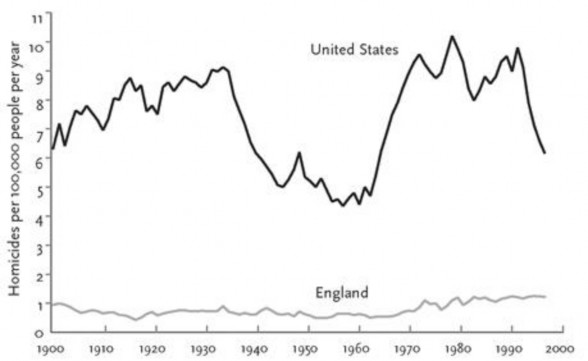
Americans aren't very generous when it comes to crime. In many European countries, even murder carries only about a 10-15 year sentence. On the other hand, I wonder if that's a product of our situation. The United States is fantastically violent in comparison to Europe, and always has been: http://ourworldindata.org/wp-content/uploads/2013/03/homicid....
E.g. Berlin is slightly bigger than Chicago. In a typical year, it might have 60-70 murders. Chicago in comparison had well over 700 this year. You can't look at the criminal justice system in the U.S. relative to our more enlightened European counterparts without keeping in mind that difference.
> The United States is fantastically violent in comparison to Europe, and always has been
Homicide != all violence. The US in fact is not fantastically more violent than Europe outside of the murder rate, which is primarily made possible by the mass distribution of guns. Europe today has twice the non-homicide crime rate that the US does. Europe's largest nation - Russia - has a homicide rate over three times that of the US.
"Contrary to common perceptions, today both property and violent crimes (with the exception of homicides) are more widespread in Europe than in the United States, while the opposite was true thirty years ago."
"In 1970 the aggregate crime rate in the seven European countries we consider was 63% of the corresponding US figure, but by 2007 it was 85% higher than in the United States."
> (And the chicken came before the egg here. Violent crime started going up in the 1960s, but it wasn't until the late 1990s that the incarceration rate had gone up by the same proportion as the violent crime rate.)
Did the incarceration rate for violent crime go up, or was it the total incarceration rate due to e.g. increased prosecution of drug arrests? If it's the former, then it's great that more violent criminals are being caught and sentenced, but if it's the latter then it's just compounding the problem.
Even if we released all drug prisoners, the incarceration rate would only be about 15% lower: http://fivethirtyeight.com/datalab/releasing-drug-offenders-.... Meanwhile, it's about 6-7 times higher than what it was in the 1960s. Thus, almost all of that growth was not from drug offenses.
It's not necessarily "great" that more violent criminals are being caught and sentenced. Many European countries manage just fine having e.g. 10-15 years maximum even for murder. Which is why I find the drug thing to be so frustrating. Drugs are not the major issue in the prison system. The real issue is whether just locking people up as a response to high crime rates actually works or not.
That's true, but the story is not that incarceration still exists, but to dispense with the argument that increased incarceration is necessary to reduce the crime rate.
I know, I'm just pointing out that the article said the opposite, ie not that longer sentences will lead to less crime, but that shorter sentences don't lead to more crime. Just picking nits.
Perhaps a measure way out on the tail of a distribution can revert most of the way toward the mean without significantly affecting other, nonlinearly correlated measures? In that case, even the grimmest nightmares of racists and prison guard unions could still come to pass, just not yet...
It probably means a crime where there is also a drug related indictment (or conviction, not sure which). Your example would be a crime of robbery, plus possession.
I wonder how many cases of 'drug related crime' are just defendants who were arrested for another crime while they had small time possession?
Punishment is almost always gratuitous. Aside from the handful of people whom society needs to be protected from, prison is always counter-productive. One of the recent stories linked here talks about how the brain doesn't really finish developing until the mid-20's, and that 20-something "kids" frequently get locked up for impulsiveness...
I had a passenger who got fined $1000 for letting his medical marijuana card expire. In the future, this fellow has it on his record that he is a political criminal who didn't hurt anyone, and a zealous brain-dead prosecutor might use this prior conviction to advocate for prison.
Another passenger had recently been released from a 2-year prison sentence. Her crime was sharing a single opiate pill with a friend. The cop was chuckling as he wrote her up. This one had gotten fat on prison food, which is not very nutritious. Several of her fellow inmates died from the neglect. (I guess police officers have to be rather disconnected from the consequences of their job. "I don't make the rules, I just enforce them" is a cop-out.)
Nassim Nicholas Taleb (author of The Black Swan, Fooled by Randomness, etc) recently had this to say:
  Being nice counts the most when
  you are nice to people ignored
  by others, deprived of attention,
  or devoid of friends. The rest is
  largely theater.
I tried to be nice to all my passengers, especially those who were having a rough day. One day I got a person going to the drive-through liquor store. I spent a few extra minutes talking to this person. After her taxi ride, I called back a time or two. There was a bit of hope in her voice - 'someone cares'. But on the third day she didn't answer, and I got distracted. Apparently she sobered up, but I didn't know that until later. After about two months this one started drinking again, found my card, and she called me because she just wanted someone nice to talk to.
This one had tried (really hard) to stay sober after almost 2-years in prison for her 3rd DUI. But life happened, and she hadn't learned how to cope in minimum-security prison.
I worked with her regularly over the course of about two years. She'd sober up, get a job, have a bad day at work, relapse... Finally I turned her over to her family (who previously had tried the "maybe mom will stop drinking if we ignore her" strategy), and she has really turned the corner now that she knows her kids are there to support her. Her son recently trusted her to watch her grandkids overnight. Prison didn't enable this transformation. (she originally fell into the alcoholic's pit when she found that vodka helped her anxiety better than the Xanax prescription. Benzodiazepines only work for about 4 weeks, before the patient's anxiety levels become worse than before.)
I'm still thinking about whether I should say more about this passenger. The Difference Between Boys and Girls [1] is about another passenger who did quite well after meeting me.
Not to detract from your otherwise excellent point and story, but I take a bit of issue with:
> (who previously had tried the "mom will stop drinking if we ignore her" strategy)
As someone who's been the child in that situation, sometimes you really just need an extended break from dealing with a parent's addiction.
It's extremely stressful and really hard to get over the resentment stemming from a childhood destroyed by a parent's addiction.
Some people are more resilient and can be there for their addicted parents as adults, but I think it's a little unfair to fault people for needing to distance themselves from their often traumatic childhoods. It's a bit like blaming soldiers for not continuing their military service after suffering a PTSD-inducing event (which hopefully we can agree is not behavior we should encourage).
Sorry if you weren't trying to imply blame or fault on the children, but that does happen fairly regularly.
I do completely understand her kids' reaction. I was able to reach their mom in a way that they couldn't, because I was an extremely over-qualified taxi driver.
Addictions are rather hard; society's efforts to punish addiction makes them harder still.
I'm really interested in Lead poisoning cases from the past decade graphed against this correlative coincidence that likely has some external variables, affecting both.
The data indicates just how much Americans need to use drugs. Imagine how big the numbers get when you scoop in prescription drugs in addition to prohibited substances. Clearly drug use is more important to large number of Americans than risk of incarceration.
Why does America have such a greater drug fascination than perhaps every other country?
>Why does America have such a greater drug fascination than perhaps every other country?
Just to throw out some random thoughts on this:
-Historically a lot more expendable income, especially in the middle and working classes. The opportunity was there, especially during the 60s and 70s when a lot of countries were still rebuilding in an economic sense.
-Our culture seems to put a lot more into individualism, especially in regards to an individuals right to the 'pursuit of happiness'. Somewhere along the way the 'pursuit of happiness' started to become centered around personal pleasure and hedonism. Think of the rock-star (or hip-hop) lifestyle that was glamorized over the past half-century. It mostly boils down to hedonism and extravagant material wealth.
-The overwhelmingly authoritarian crack-down on drugs in America made it a cornerstone of the anti-establishment counter-culture movement. Though perhaps that's a bit backwards, the crack-down came about as a way to control and suppress the counter-culture. But that backfired in a big way. Drugs have practically become a rite of passage into being cool or rebellious. I bet half as many teenagers would try drugs if it weren't for that perception.
-Americans largely enjoy simplicity and convenience. We don't want to make huge lifestyle changes. Take a pill or something to make the problems go away. Simple, easy, don't have to think about it. Gib me my soma.
-The Media. A lot of TV shows and movies are centered around topics that are edgy, illegal, and/or borderline taboo because that's what people want to watch. We always have. Same way we rubberneck for a car crash. I think that's helped normalize drugs.
I'm just throwing this out there, but it looks like European countries have invested a lot more in social programs which were rather successful. e.g. universal healthcare, unemployment benefits, better prison systems and perhaps most important, affordable education for everyone. They have not been distracted by the absurd and time consuming debates on things like gay rights, climate change, evolution etc. (I'm not saying that these issues are not important, but simply that they are a non-issue in Europe. Climate change is acknowledged as a scientific fact. So is evolution. People are not discriminated based on their sexual orientation.)
Not saying that the system doesn't have drawbacks, but it seems to have led to a higher standard of living, a more equitable distribution of wealth, although perhaps not as much economic growth as the US.
I'm not confirming or denying that the US has maybe the worst drug problem in the world - seems plausible. But, on addiction (slightly different, but related), Rat Park is an interesting point of focus.
It's violent crime which has dropped. Additionally, lengths of prison sentences have greatly increased, even as crime rates dropped, especially due to war on drugs legislation and three strikes laws.
Appealing to "Dr" Pryor doesn't cut it, I'm afraid. Please step back and examine your line of argument here. You're making unfavored claims based on what you call 'reason' and seem unwilling to consider contrary evidence.
It's fine to have a contrary opinion, but please refrain from spreading misinformation if you don't care to engage with the topic at hand.
Can you think for yourself without authorities, man? I know it's hard.
This passage from the Economist article I think nicely, and unintentionally, demonstrates the level of insanity here:
The result was that some 20,000 convicts who otherwise would have been sent to prison remained free. The state incarceration rate reverted to 1990s levels without an attending rise. Indeed, studies found no effect on violent crime and a small effect on property crime. (Each year of prison not served due to California's reform was estimated to cause an additional 1.2 auto thefts.) However, the social cost of a stolen Corolla is not clearly greater than the cost to taxpayers of a year of prison time.
So, 20,000 innocent people per year have their cars stolen. But no biggie! Without plutonium, how would we have electricity? If someone steals 1.2 cars per year, why lock him up? It's not worth the cost of a "Corolla."
The result is the insane predatory atmosphere of a normal American (for me, SF) street, in which anyone with any sense is on yellow alert all the time except behind locked doors. As for my children, I'm resigned to being a helicopter parent until they're old enough to... defend themselves, I guess? Should probably start with those karate lessons now.
Meanwhile, in Japan, which has zero tolerance for crime, you can send your five-year-old around the corner to buy milk. Have you ever lived in a crime-free society? Even visited? Try it sometime -- the feeling is downright amazing. You really don't know what you're missing.
I was sent to buy milk when I was seven. I had to walk several blocks to do it. I never suffered any crime, and actually, I was walking through a slightly worse neighborhood than I lived in to get to the convenience store.
Even most criminals don't attack children. Stop propagandizing in this thread.
That wasn't an appeal to authority, just an appeal to reason.
You'll have to forgive me if I prefer to trust Dr. Pryor and common sense over the Brookings Institution's "studies and accidental experiments."
If people were fruit flies and it was possible to actually conduct controlled experiments in "social science," I'd be happy to take their results seriously. Or more to the point, if controlled experiments were possible, no one would take uncontrolled experiments seriously (not to mention studies by the Brookings Institution, with its very large axe to grind -- see the Moskos commentaries on Brookings research linked above).
But the definition of science isn't "the best we can do." When actual science isn't physically practical, "the best we can do" is not science but pseudoscience. Fortunately, there are other ways to use our brains.
I feel like one becomes a jacked dude with prison pecs by the experience of being in prison, and a Eucharistic minister by the experience of being somewhere rather different from prison.
Which is to say, the crime-prone-ness of people currently under mass incarceration, were they to be mass decarcerated today, is probably not well correlated with their crime-prone-ness had they never been imprisoned in the first place. So if we want to model the effect of reducing mass incarceration, whether scientifically or by thought experiments with alb-vested street gangs, we should not model the effect of unlocking the prison gates and assume that this is an equivalent scenario.
(We can even talk about how life would have been for these people if they had been working in industries that weren't classified as illegal. For instance, if you wanted to be a major marijuana trafficker several years ago, there'd be a certain inherent underworld element to your life even if you never got caught, and the externalities of you living that life were probably bad for society. But if you want to do it today, YC or someone will fund you and the externalities of your life will probably be good for society. But that conversation might be too nuanced or too awkward to have in a reasonable fashion.)
> Drug offenders accounted for half of federal prisoners and 16 percent of state prisoners in 2015. The decrease in the federal prison population was largely due to shorter drug sentences authorized by Congress and the U.S. Sentencing Commission.
> During fiscal year 2015, the Federal government received approximately $3.25 trillion in tax and fee revenue and had outlays (spending) of $3.7 trillion;
> In total, 6,899,000 adults were under correctional supervision (probation, parole, jail, or prison) in 2013 – about 2.8% of adults (1 in 35) in the U.S. resident population.
So our federal government would be 0.1% smaller in terms of expenses if it weren't responsible for drug offenses, but a full 1.4% of the population is under their control as a result. 2% of the population has lost its right to vote, so perhaps 1% due to drug offenses.
That's about half the number of Jews in the US, which both political parties pander to quite heavily(making Israel a huge point of contention in any election). I guess that makes sense: drug reform is less visible than Israel in the news but still significant, though I haven't measured it to say that it's half.
You're actually allowed to discriminate against people and take away their right to vote, but the states are punished by reducing their representational basis so they get fewer legislators and electors in elections. Since we have a winner-takes-all system, this encourages states to allow all minority groups to vote if they wouldn't tip the election. I was originally thinking it'd be strange for states to reduce their basis by as much as 1%, but it looks like there's an exemption for crimes:
> Representatives shall be apportioned among the several States according to their respective numbers, counting the whole number of persons in each State, excluding Indians not taxed. But when the right to vote at any election for the choice of electors for President and Vice President of the United States, Representatives in Congress, the Executive and Judicial officers of a State, or the members of the Legislature thereof, is denied to any of the male inhabitants of such State, being twenty-one years of age, and citizens of the United States, or in any way abridged, except for participation in rebellion, or other crime, the basis of representation therein shall be reduced in the proportion which the number of such male citizens shall bear to the whole number of male citizens twenty-one years of age in such State.
I suppose, strictly speaking, you could have your right to vote stripped away if you get a parking ticket? I wonder if it's a gerrymandering scheme to throw Democrats in prison and take away their right to vote. (Democrats tend to be big on drugs)
Since drug use counts towards the arrests but probably doesn't count towards the crime rate(it's a victimless crime, and the offender doesn't report it), that portion of it shouldn't affect the link described in the article.
I'm not sure it's smart to directly compare percentages like the article does. If the crime rate is already low because all the criminals are locked up, then you'll have no change in crime rate and a low change in imprisonment. And you usually want to compare derivatives of the log-percentage, not the percentage directly.
Support for Israel isn't just about pandering to Jews. There are a lot of fundamentalist Christians who believe Israel's existence is necessary for Christ's return, that allying ourselves with Israel is being on God's side, etc.. I doubt it would be worth making political hay out of it if Jews were the only ones who cared.
There appears to be a only small correlation to the overall trend down, and economic growth. For example, crime declined in 2008 and 2009 when the economy was still flat and unemployment was high. Crime did tick up slightly leading into the recession, though not substantially. So while it has some impact, it doesn't look like it accounts for the broad trend down since the 90s.


And homicide rates have risen substantially in the last two years (up 10.4% in 2015, and projected for 13.1% this year). These are the biggest increases in a generation.
http://www.copinthehood.com/2016/09/spin-this-biggest-murder...
http://www.copinthehood.com/2016/11/homicide-is-up-and-its-n...
I'm not sure if the de-incarceration is responsible for the rise in crime. From my following, it seems like the police backing off in response to protests, riots, and consent decrees has a bigger impact. And I'm not a fan of prison -- there are better ways to deter crime and to keep violent criminals away from normal people. But I do notice that most times when I see a murder in the news, and the suspect has been apprehended, the suspect has a disturbingly long wrap sheet and I've wondered to myself, "how was this person allowed back out into civilized society."